
When patients arrive with fibrosis, Peyronie’s disease, revision surgery, or anatomically demanding situations, Coloplast penile implant almost always enters the conversation. The Danish manufacturer has been engineering urological devices for decades, and its prosthetic line is built around one principle that matters in the operating room: predictable mechanical behavior, even when the anatomy is not.
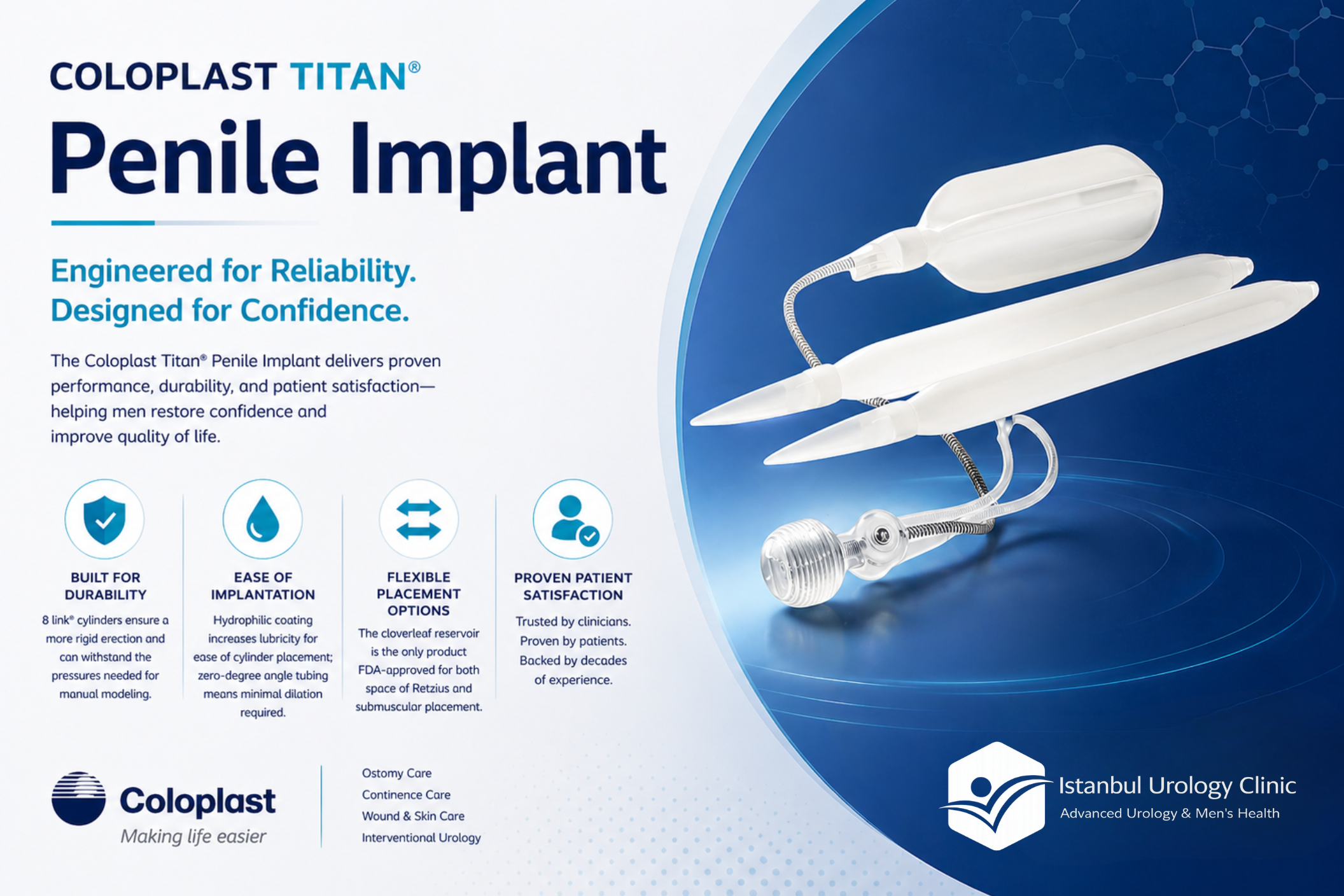
Coloplast is not a single implant. It is a family of three devices built for three distinct patient profiles. The Titan is the rigidity-focused inflatable for dense, scarred, or compromised corporal tissue. The Titan Touch uses the same cylinders and reservoir but introduces a redesigned pump that significantly reduces the hand strength required for inflation. The Genesis is the malleable option, reserved for cases where simplicity outweighs everything else.
The decision between these three is rarely about brand preference. It comes down to corporal anatomy, hand function, and what the patient needs the implant to do over the next fifteen years. This guide walks through that decision within the Coloplast range. For a broader view of all implant options, see our complete penile implants guide.
- Why Coloplast Is a Trusted Name in Prosthetic Urology
- The Coloplast Penile Implant Family at a Glance
- Coloplast Titan: The Rigidity-Focused Inflatable
- Titan Touch: Engineered for Easier Activation
- Coloplast Genesis: The Malleable Option in the Family
- How to Decide Between Titan, Titan Touch, and Genesis
- Bioflex and HydroVANTAGE: The Engineering Behind Coloplast
- Sizing and Customization
- What Bioflex Does That Silicone Cannot
- Recovery, Cost, and Sourcing
- Conclusion
- Why Coloplast Is a Trusted Name in Prosthetic Urology
- The Coloplast Penile Implant Family at a Glance
- Coloplast Titan: The Rigidity-Focused Inflatable
- Titan Touch: Engineered for Easier Activation
- Coloplast Genesis: The Malleable Option in the Family
- How to Decide Between Titan, Titan Touch, and Genesis
- Bioflex and HydroVANTAGE: The Engineering Behind Coloplast
- Sizing and Customization
- What Bioflex Does That Silicone Cannot
- Recovery, Cost, and Sourcing
- Conclusion
Key Points
- Coloplast offers both inflatable and malleable penile implants within a single integrated prosthetic family.
- Titan is a three-piece inflatable designed around strong axial rigidity, selected for fibrosis, Peyronie’s disease, and revision cases.
- Titan Touch shares identical cylinders and reservoir with the Titan but uses a redesigned pump requiring significantly less hand strength.
- Genesis is the malleable implant for neurological conditions, severely limited dexterity, or mechanical simplicity priority.
- Model selection depends on anatomy, hand function, and long-term goals, not brand familiarity.
Why Coloplast Is a Trusted Name in Prosthetic Urology
Coloplast entered prosthetic urology in 2006 through its acquisition of Mentor Corporation’s urology division, which is why the Titan line carries decades of clinical history that predates Coloplast’s ownership. The device has been refined across multiple generations, and its mechanical behavior is predictable.

Two proprietary technologies define the line:
- Bioflex: the polyurethane-based polymer used in Titan and Titan Touch cylinders. Unlike silicone, Bioflex resists radial expansion under inflation, which translates into stronger axial rigidity. This is why the Titan dominates in fibrotic and Peyronie’s cases.
- HydroVANTAGE: a hydrophilic coating that absorbs an antibiotic solution chosen by the surgical team before placement, adding measurable infection protection in higher-risk patients such as diabetics or revision cases.
Coloplast also maintains a lifetime device replacement program for its inflatable implants. A mechanically failed Titan or Titan Touch is replaced at no device cost, regardless of how many years have passed.
The Coloplast Penile Implant Family at a Glance
Three models, three clinical situations. The right choice usually becomes clear once anatomy and hand function are evaluated together.
The Titan and Titan Touch share identical cylinders, reservoir, and Bioflex material. The only difference is the pump mechanism, making the choice between them a hand function decision rather than a rigidity decision. The Genesis sits in a separate category as a malleable implant with no hydraulic system.
Coloplast Titan: The Rigidity-Focused Inflatable
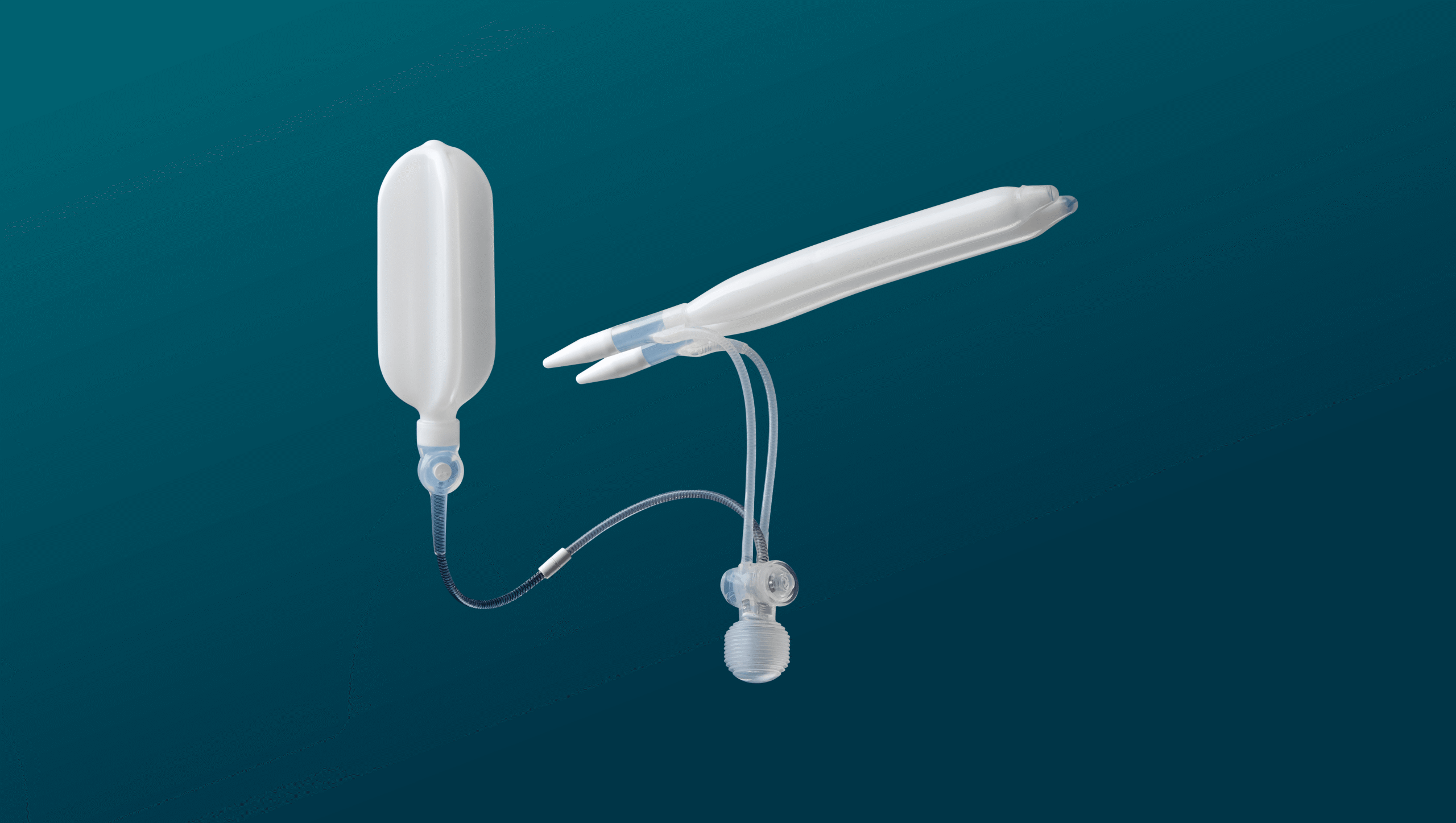
The Titan is the foundation of the Coloplast inflatable line. Three-piece inflatable prosthesis built around one engineering priority: strong axial rigidity during inflation, with a soft concealable flaccid state.
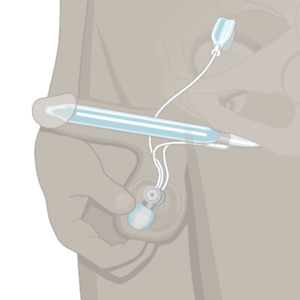
The rigidity comes from Bioflex cylinders. Unlike silicone, Bioflex resists radial expansion under inflation, which transfers pressure axially rather than sideways. In practical terms, the penis stands straighter and holds its position better under lateral force during intercourse. This matters most when corporal tissue is no longer cooperative, since fibrotic or scarred tissue offers less natural support and the implant has to compensate.
This is why the Titan dominates in three specific clinical situations:
- Peyronie’s disease: cylinders push against fibrotic plaque to correct curvature and maintain straightness under load.
- Corporal fibrosis: cylinders expand against resistance from scar tissue that softer implants struggle to overcome.
- Revision surgery: altered tissue planes, reduced compliance, and unpredictable corporal dimensions from previous implant placement.
In each scenario, a softer expansion-focused cylinder would either fail to deliver adequate rigidity or behave unpredictably under load. The Titan also includes a hydraulic lock-out valve preventing unintended partial inflation, an internally concealed reservoir, and the HydroVANTAGE antibiotic coating.
For the full inflatable implant overview including surgical procedure, recovery, and sizing, see our inflatable penile implants guide.
Titan Touch: Engineered for Easier Activation
The Titan Touch is not a different implant. Same Bioflex cylinders, same reservoir, same HydroVANTAGE coating, same hydraulic mechanics. What changes is the pump.
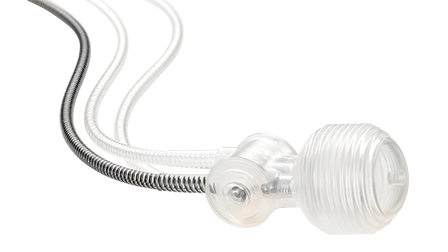
The redesigned pump sits lower in the scrotum, uses a softer activation surface, and requires noticeably less squeeze force to inflate. The deflate button is enlarged and easier to locate by touch. Patients typically inflate the device fully with one hand and minimal effort once healed.
This addresses a real problem in a meaningful portion of the patient population:
- Diabetic neuropathy: reduced fine motor coordination and tactile sensitivity
- Rheumatoid or osteoarthritis: reduced grip strength and thumb flexibility
- Long-term diabetes: combined reduced sensation and strength
- Age-related hand decline: gradual loss of pump operating capacity in the late sixties and seventies
The Titan vs Titan Touch conversation happens after the rigidity question is settled. Once an inflatable with strong axial support is the right category, the next question is hand function. If grip strength or dexterity are likely to decline over the next ten to fifteen years, the Touch is the safer long-term decision even if a standard pump works comfortably today. No functional trade-off. Same rigidity, same concealment, same durability.
Coloplast Genesis: The Malleable Option in the Family
The Genesis is Coloplast’s malleable implant, and it occupies a deliberately narrow place in the family. Not an alternative to the Titan for patients who simply want to avoid an inflatable. The correct choice for specific clinical situations where simplicity, mechanical reliability, and zero pump dependence are requirements, not preferences.

The Genesis core uses a silver-coated central wire surrounded by stainless steel coils, designed to maintain positional memory without kinking or fracturing over years of repeated bending. The rods come in multiple diameters and can be trimmed intraoperatively to match corporal length.
Genesis is the right choice for:
- Spinal cord injury: neurogenic bladder management, transfers, and self-catheterization make pump operation genuinely difficult
- Severe arthritis or post-stroke patients: hand function too compromised even for the Titan Touch pump
- Significant cognitive limitations: inflation and deflation steps cannot be reliably learned or remembered
- High infection risk cases: reducing mechanical complexity and surgical time lowers risk in immunocompromised patients
What the Genesis does not offer is concealment. The penis remains in a permanent semi-erect state and bends downward for daily activity. For many younger or socially active patients, this is why the Titan or Titan Touch is the better choice. For the right patient, the simplicity is exactly what makes the implant work long-term.
For broader malleable comparisons across manufacturers, see our malleable penile implant guide.
How to Decide Between Titan, Titan Touch, and Genesis
Three questions in order: what does the corporal anatomy require, what can the hands reliably do over the next fifteen years, and what does the patient’s life look like during that time. By the time those three are answered, the implant usually selects itself
Scenario A: Severe ED with Peyronie’s Curvature
Mid-fifties patient with significant ventral curvature, palpable plaque, no response to PDE5 inhibitors or injections. Hands work normally. Choice: Titan. Bioflex cylinders generate the axial force needed to push against plaque during intraoperative modeling. A softer cylinder would absorb the force rather than transfer it into the tissue.
Scenario B: Diabetic Patient, 65+, with Mild Arthritis
Late sixties, type 2 diabetes for fifteen years, early arthritis in both hands. Standard rigidity needs, but reduced grip strength and finger flexibility that will worsen over time. Choice: Titan Touch. Same cylinders and outcomes as Titan, but the redesigned pump means independent operation for the full implant lifespan rather than struggling within five years.
Scenario C: Post-Spinal Injury with Limited Dexterity
Wheelchair-dependent, spinal cord injury affecting the chest area, neurogenic bladder requiring catheterization several times daily. Hand function preserved but already managing multiple daily medical tasks. Choice: Genesis. Eliminating pump and reservoir reduces both surgical complexity and daily operational burden.
Scenario D: Revision After Explanted Implant with Heavy Fibrosis
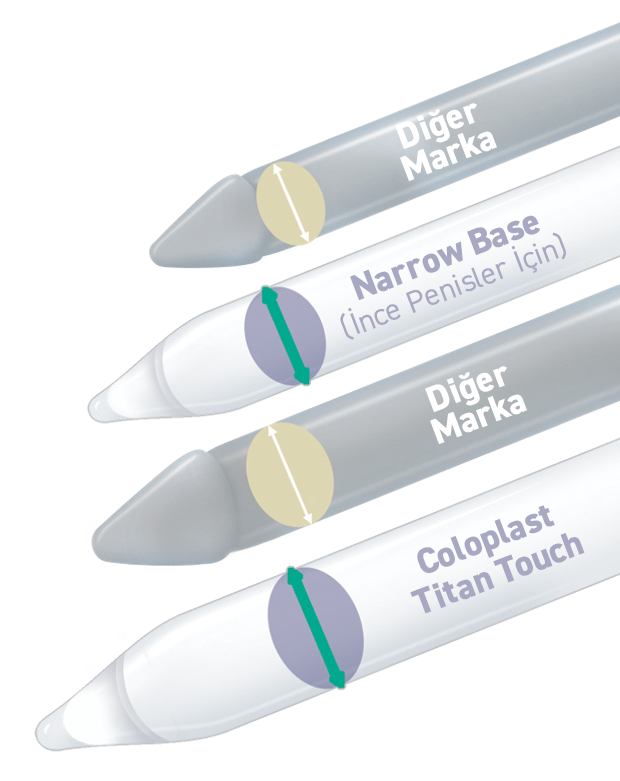
First implant removed two years ago due to infection. Imaging shows heavily scarred internal tissue, narrowed corporal space, stiffer walls. Choice: Titan with narrow-base cylinders. Narrow base allows proper seating in non-compliant chambers, and Bioflex rigidity compensates for reduced natural tissue support.
Scenario E: Active Younger Patient, Concealment Priority
Early forties, physically active, single, primarily concerned about concealment at the gym, swimming, and intimate settings. Standard rigidity needs, excellent hand function. Choice: Standard Titan. Both inflatables deliver excellent flaccid concealment. The standard pump sits well for patients with normal hand function.
Patterns repeat. The Titan handles complex anatomy. The Titan Touch handles complex hands. The Genesis handles complex lives where mechanical simplicity is the priority.
Quick Reference: Which Coloplast Penile Implant Model Fits Your Situation?
| Choose this model | If this applies |
|---|---|
| Titan | Rigidity priority for complex anatomy, Peyronie’s disease, fibrosis, or revision surgery, with reliable hand function. |
| Titan Touch | Same rigidity needs as Titan, but arthritis, neuropathy, or age-related hand decline could compromise pump operation over time. |
| Genesis | Pump operation is not viable, whether due to spinal cord injury, severe arthritis, cognitive limitations, or high infection risk. |
Final selection happens during consultation, after anatomical examination and hand function evaluation.
Bioflex and HydroVANTAGE: The Engineering Behind Coloplast
Two materials define the mechanical and biological behavior of the Coloplast inflatable line.
Bioflex
Polyurethane-based polymer used in Titan and Titan Touch cylinders. Under inflation, it resists radial expansion more firmly than silicone, which translates into greater axial column strength. The penis stands straighter and holds position better under lateral force during intercourse. This is the property that makes the Titan reliable in fibrotic tissue and Peyronie’s cases, where the cylinder must transfer force into surrounding anatomy rather than absorb it.
Video courtesy of Coloplast. Uploaded and hosted locally for educational display purposes.
HydroVANTAGE
Hydrophilic surface coating applied to the entire implant. Before placement, the device is dipped in an antibiotic solution chosen by the surgical team. The coating retains that solution locally around the implant for the critical hours immediately after surgery. One component of infection prevention, not a replacement for sterile technique or patient optimization. In diabetics, revision cases, and other higher-risk situations, it adds measurable protection.
Sizing and Customization
Coloplast’s range covers a wider span of anatomical situations than most patients realize. Two patients with the same diagnosis can have completely different corporal anatomy, and the implant has to match the patient, not the average.
| Sizing option | When it matters |
|---|---|
| Narrow-base cylinders (Titan / Titan Touch) | Fibrotic cases where the proximal corpora is narrower than normal. Prevents perforation, asymmetric placement, or chronic discomfort. |
| XL cylinders (Titan / Titan Touch) | Longer corporal lengths. Prevents SST deformity (glans droop) caused by cylinders that are too short for the patient’s anatomy. |
| Genesis intraoperative trim | Multiple rod diameters with intraoperative length adjustment. No hydraulic components to size around means more anatomical flexibility on the table. |
Anatomical variation is the rule, not the exception. Working with a manufacturer offering narrow-base, standard, and XL configurations across the inflatable line, plus a malleable option with intraoperative trim flexibility, is one of the strongest predictors of long-term satisfaction.
What Bioflex Does That Silicone Cannot
The most common question patients run before consultation is how Coloplast compares with Boston Scientific. The answer that actually matters is not a feature list. It is what the cylinder material does inside the corpora over fifteen years, and where one material outperforms the other clinically.
Coloplast cylinders are built from Bioflex, a polyurethane-based material developed specifically for prosthetic urology. AMS 700 cylinders use a three-layer silicone construction refined across five decades. Both materials are biocompatible, both have decades of clinical follow-up, and both produce reliable inflatable implants. The differences become meaningful in two specific clinical situations.
Dense corporal fibrosis. When the inside of the erection chambers has been scarred by years of severe erectile dysfunction, advanced Peyronie’s disease, or prior implant removal, the cylinder material has to hold its shape against tissue that no longer cooperates. Bioflex holds axial rigidity in this environment more reliably than silicone, which is why Coloplast Titan is our default recommendation for revision surgery and complex Peyronie’s cases.
Length-preservation priority. The Boston Scientific AMS 700 LGX is engineered specifically for controlled length and girth expansion through its three-layer silicone design. Coloplast does not compete in this category — Titan cylinders are designed for rigidity, not expansion. The patient prioritizing length recovery is the patient where AMS 700 LGX is the stronger recommendation.
For the full brand-by-scenario decision logic across all three manufacturers we work with, see our inflatable penile implant guide.

Recovery, Cost, and Sourcing
Recovery follows the standard inflatable or malleable timeline: hospital discharge within 24 hours, return to office work within 7 to 10 days, sexual activity cleared at week 6. First activation training happens at the postoperative visit before discharge. Full week-by-week breakdown in our penile implant recovery guide.
Cost tracks the implant category. Titan and Titan Touch fall within the standard inflatable range. Genesis falls within the malleable range. Cylinder configuration (standard, narrow-base, XL) moves the figure within the band. Full breakdown in our penile implant cost guide.
Sourcing goes through Coloplast’s authorized distribution channel with full traceability from factory to operating room. Each device arrives sealed with serial number, lot tracking, and warranty documentation, registered in the patient’s name immediately after surgery. The Coloplast lifetime replacement program only validates properly registered implants.
Frequently Asked Questions
No. Same Bioflex cylinders, same reservoir, same HydroVANTAGE coating, same hydraulic mechanics. The only difference is the pump, which is redesigned for easier activation in patients with reduced hand strength.
Yes. Switching between Titan, Titan Touch, or even to Genesis during revision is technically straightforward as long as the corporal anatomy supports the chosen model. The decision is made during preoperative evaluation based on what the previous surgery left behind.
For specific clinical situations. Coloplast's Bioflex cylinders deliver stronger axial rigidity than silicone alternatives, which matters in fibrosis, Peyronie's, and revision cases. Other brands engineer toward different priorities. The choice is anatomical, not brand-based.
Yes, in specific cases. Spinal cord injury, severe arthritis beyond what the Titan Touch pump can accommodate, cognitive limitations, and high infection risk situations where reducing mechanical complexity matters. Genesis is not a downgrade. It is the correct device for the right patient.
Three questions answer it: what does your corporal anatomy require, what can your hands reliably do over the next fifteen years, and what does your daily life look like. Anatomical examination and hand function evaluation during consultation make the final selection.
Yes, as long as the implant is registered properly at the time of surgery. The warranty follows the device and the patient, not the country of placement. Replacement device cost is covered. Surgical fees for the replacement procedure are billed separately at prevailing rates.
Once healed, both Titan and Titan Touch are designed for complete concealment in the flaccid state. Genesis remains semi-rigid and is bent downward for daily wear. Most patients report no sensation of the device during walking, sitting, or normal activity after the initial healing period.
Modern inflatable implants typically function reliably for 10 to 15 years, sometimes longer. Mechanical failure rates are low across the device lifespan. When failure does occur, the lifetime warranty covers the replacement device.
Inflatable implants contain minimal metal and rarely trigger walk-through metal detectors. Body scanners may show the device outline. A simple disclosure to security personnel resolves any question. Many patients carry the implant identification card provided after surgery.
No. The Titan is engineered for rigidity, not expansion. The implant restores function at the patient's existing anatomical dimensions. If postoperative length preservation is the priority, the Boston Scientific AMS 700 LGX is the device engineered specifically for that purpose.
Conclusion
Coloplast is a coordinated family of three devices built to handle the full range of clinical situations. The Titan delivers rigidity where the anatomy demands it. The Titan Touch protects long-term function when the patient’s hands cannot be relied on indefinitely. The Genesis offers mechanical simplicity where simplicity is the right answer.
The decision is never about the brand. It is about matching the right device to the patient’s anatomy, hand function, and life.