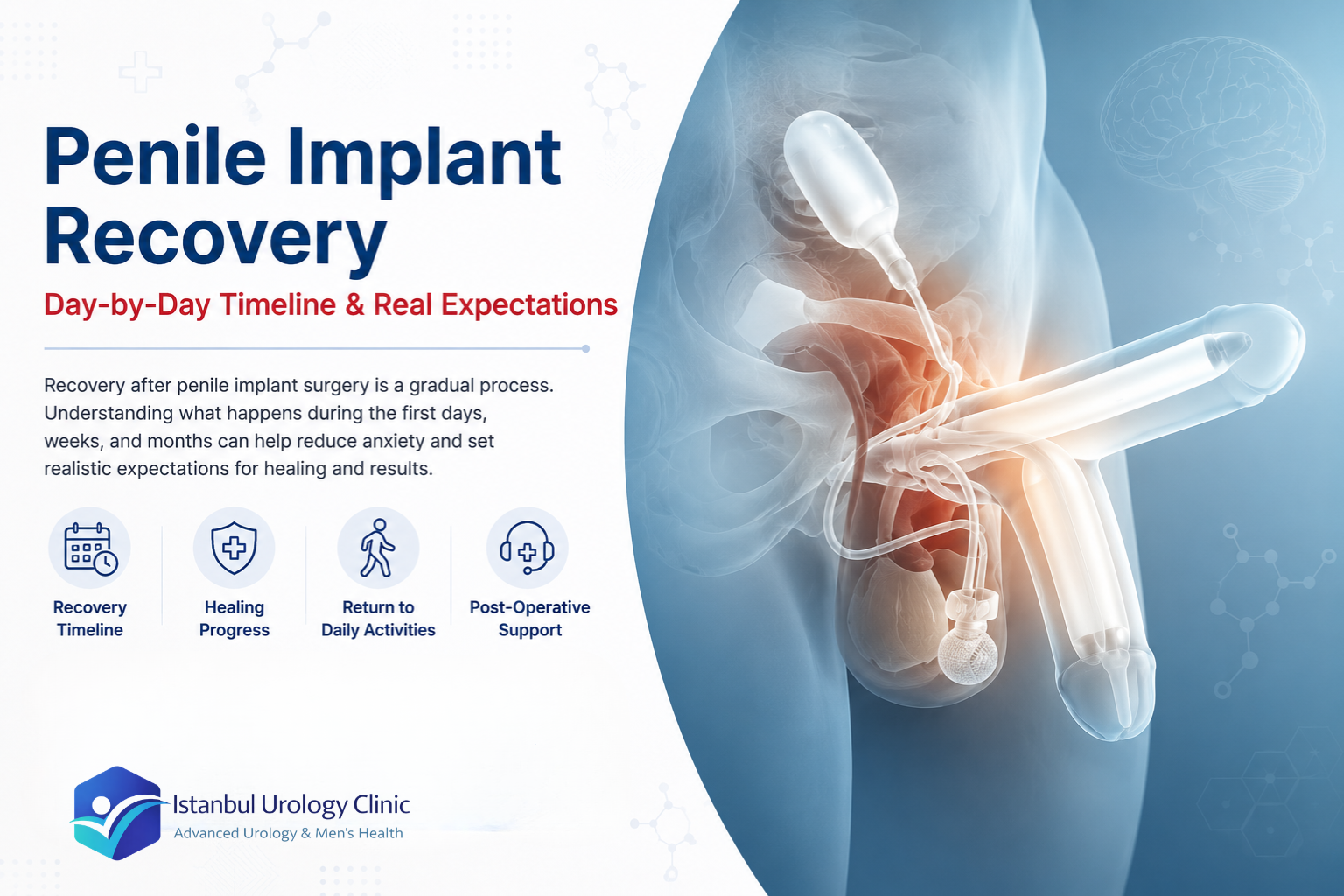
The first three days are the most physically intense part of the entire penile implant recovery, and they are also the most misunderstood. Patients often expect sharp pain similar to other surgeries, but the dominant sensation is rarely pain. It is swelling, heaviness, and a strong awareness that something internal has changed.
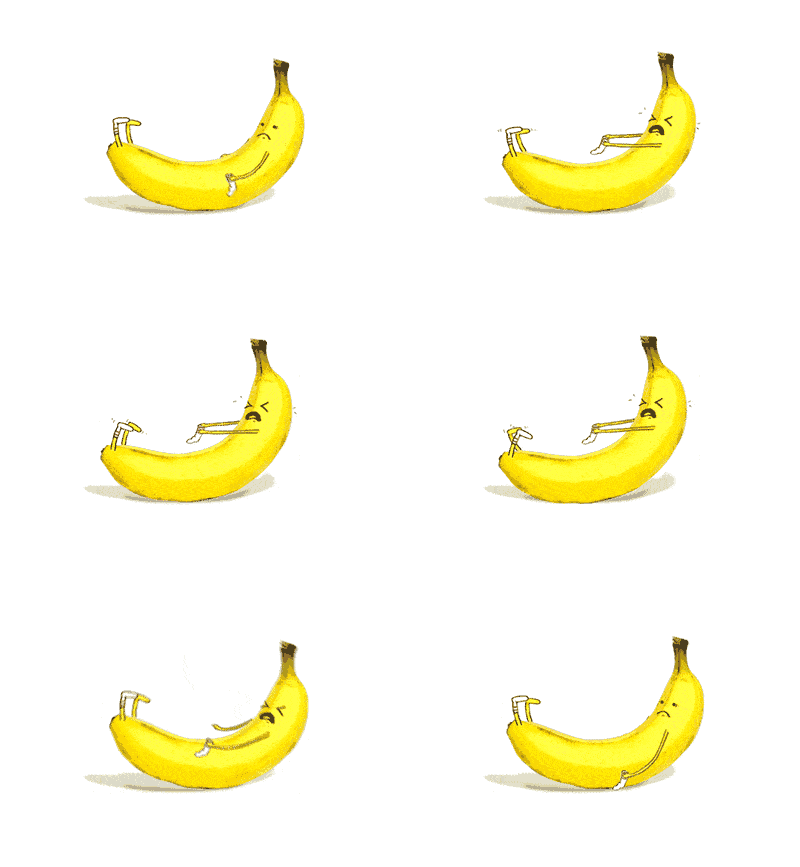
The penis is positioned upward against the lower abdomen with a supportive dressing, and the scrotum visibly enlarges during the first 24 to 48 hours as fluid accumulates around the surgical area. This temporary appearance can be alarming for patients who were not prepared for it, which is why we describe it in detail before surgery.
Once the patient is discharged and settled at the hotel, the focus shifts to rest, controlled movement, and managing the early swelling with elevation and supportive underwear. The first night is usually the most uncomfortable because the body is still processing the surgical stress and the anesthesia is fully clearing. Walking to the bathroom feels heavier than expected, sitting requires adjusting position, and lying flat on the back becomes the most natural sleeping posture. By the morning of day two, most patients describe the experience as easier than they anticipated, which becomes a turning point in the early recovery mindset.
What Patients Usually Notice During This Stage
- Significant scrotal swelling that may make the area appear much larger than its final size
- Mild to moderate bruising that can extend toward the lower abdomen or upper thighs
- A pulling or tight sensation at the surgical site, especially when standing up from sitting
- Temporary numbness or tingling at the tip of the penis or surrounding skin
- A persistent awareness of the implant that gradually fades over the following days
Swelling is the part of penile implant recovery that worries patients the most during the first week, often more than the surgery itself. The good news is that it follows a predictable pattern, and knowing what to expect at each stage prevents unnecessary anxiety during the days when the appearance looks more dramatic than the actual healing.

Most of the visible swelling peaks around day 3 and starts to retreat noticeably by day 7. By the end of the second week, the scrotal area has returned to roughly 70 to 80 percent of its normal appearance, and by week 4 most patients describe themselves as looking and feeling close to baseline. Residual swelling at a microscopic level continues for several more weeks, but it is not something the patient feels or notices in daily life.
The duration is influenced by a few practical factors. Patients who limit their walking during the first two weeks, wear supportive underwear consistently, and avoid prolonged standing recover visible swelling faster than those who push activity too early. Diabetic patients and those with longstanding tissue fibrosis may take an additional week or two for full resolution. Sudden, severe, or one-sided swelling is different from normal recovery swelling and should be reported to the surgical team for evaluation.
This is the question that holds many patients back from scheduling surgery, and the honest answer is reassuring. Penile implant recovery is consistently described as less painful than expected, and significantly less painful than other surgeries with shorter recovery times. The pain profile is moderate, controlled, and short, with most patients reporting that the experience never required them to push beyond the prescribed pain management plan.
 Pain typically peaks between day 2 and day 3, when surgical inflammation is at its highest. From day 4 onward, the intensity drops steadily, and by the end of week one most patients describe their sensation as mild discomfort rather than pain. Roughly 75 percent of patients report on the day after surgery that they feel well enough to be at home rather than the hospital, which gives an accurate picture of how the early days actually feel.
Pain is managed with a structured medication plan that includes an anti-inflammatory pain reliever taken after meals throughout the first two weeks. The deep surgical sensation people imagine before the operation rarely matches the reality of the day after it, and patients who have undergone other procedures often compare penile implant recovery favorably to hernia surgery, prostate procedures, or even dental extractions. Sharp pain, severe pain, or pain that increases rather than decreases after day four is not normal and should be reported to the surgical team.
Every patient leaves the hospital with the same written protocol, regardless of implant type or nationality. These are not generic recommendations pulled from a textbook. They are the exact instructions refined across years of post-operative follow-up, and each one exists because skipping it has a specific clinical consequence with documented impact on healing.

- No sexual activity for 6 weeks. Protects the healing tissue around the cylinders and allows the body to form a stable capsule around the implant before any mechanical stress is applied.
- Complete the full antibiotic course as prescribed. Reduces the rare but serious risk of implant infection. Stopping early when symptoms improve is one of the most preventable causes of complications.
- Wear tight supportive underwear for one month, with the penis positioned upward toward the abdomen. Maintains correct positioning during scar tissue formation and prevents downward curvature that becomes difficult to correct later.
- Limit walking to about 30 minutes per day during the first 15 days. Controls scrotal swelling and prevents fluid accumulation. Prolonged standing in the first two weeks is the most common reason for delayed swelling resolution.
- No showering for the first 6 days. Keeps the surgical site fully dry while the incision seals. Early moisture exposure increases the risk of wound contamination.
- No gym, sea, swimming pool, or Turkish bath for one month. Avoids bacterial exposure from communal water sources and protects the healing area from pressure, friction, and heat.
- Do not lift objects heavier than 5 kg (11 lbs). Prevents abdominal pressure on the reservoir position and avoids strain on the surgical incision during the first weeks of healing.
- Drink at least 2 liters of water daily. Supports tissue healing, reduces post-operative urinary discomfort, and helps the body clear medications efficiently.
- Follow a vegetable-rich, cooked-food diet. Prevents constipation, which causes abdominal straining that places direct pressure on the surgical area and can delay healing.
Patients who follow this protocol carefully recover faster, with less swelling, fewer follow-up concerns, and a smoother transition to the activation phase. The instructions look simple, but the consistency of following them across the full recovery window is what separates straightforward healing from complicated healing.
The most consistent feedback during the first follow-up after surgery is that the experience was easier than the patient had been preparing for. Roughly 75% of patients describe themselves on the day after surgery as comfortable enough that they would rather be at home than in the hospital, simply because they no longer feel the need to be there. The sharp surgical sensation people imagine before the operation rarely matches the reality of the day after it. What dominates the first week is not pain. It is patience.

The body is healing internally at a pace that does not match how recovered the patient feels externally, and rushing this window is the most common reason for setbacks observed in follow-up visits. Most patients are surprised by how quickly they feel functional, and the temptation to push activity forward is strong. This is exactly the period where pulling back, resting, and trusting the timeline pays the biggest long-term dividend.
Every patient leaves the clinic with a complete medication package designed to cover roughly 15 days of recovery. The protocol typically combines a stomach protector taken before breakfast, two antibiotics with different mechanisms to minimize infection risk, a single dose antifungal, and an anti-inflammatory pain reliever taken after meals. The exact schedule is reviewed with the patient before discharge so that timing, food interactions, and full course completion are clearly understood. Wearing tight supportive underwear around the clock keeps the penis positioned upward against the abdomen, which is essential for proper scar tissue formation and for preventing downward curvature as the implant settles.
When Discomfort Crosses Into a Warning Sign
Some discomfort during week one is expected and self-limiting. Other signs are not, and patients should contact the surgical team immediately if any of the following appear.
- Fever above 38°C or persistent chills
- Increasing rather than decreasing pain after day four or five
- Any discharge, pus, or unusual odor from the incision site
- Sudden, severe, or rapidly worsening swelling on one side
- Difficulty urinating or inability to pass urine for more than 6 to 8 hours
- Redness spreading outward from the incision area
The shift between week one and week two is more noticeable than patients expect. The swelling has retreated significantly, the incision has sealed, and most men report feeling like themselves again during normal daytime activity. This is when life starts returning.

Office work becomes manageable by day 10 to 14, short driving is possible once the patient is fully off prescription painkillers, and international travel home is generally cleared during this window after a final dressing check. The catch is that this physical comfort can be misleading. The surface has healed, but the deeper tissue around the implant is still in the middle of its most important integration phase, and intimacy is still a few weeks away.
The two implant types diverge clearly during this stage. Inflatable patients are usually given specific instructions about manual handling of the pump area as the scrotal tissue softens, which makes the eventual activation visit smoother. The implant remains deactivated, but light, gentle positioning of the pump helps it settle into its final accessible location.
Malleable patients have a different focus. The rods are already in place and functional, but the surrounding tissue is still healing around them. Adjusting the position of the penis upward and downward is practiced gently and briefly, mostly to confirm comfort, while sexual use is still firmly postponed until the surgical team confirms full healing.
Return to work depends almost entirely on the physical demands of the job, not on how recovered the patient feels in general. Most patients with desk-based work return between day 10 and day 14, while those with physically demanding roles wait three to four weeks before resuming full duties.

Office workers, remote workers, and patients in administrative or management roles are usually cleared to return around day 10 to 14, often working from home for the first few days to manage prolonged sitting comfortably. By the second week, the prescription pain medication has been replaced by standard anti-inflammatory tablets, focus has returned, and the swelling no longer interferes with normal clothing or seated posture.
Physically active jobs require more patience. Construction workers, drivers handling heavy loads, warehouse staff, farmers, and patients whose work involves lifting, climbing, or extended standing should plan for three to four weeks away from full duties. The 5 kg lifting restriction during the first weeks is not negotiable, and pushing physical work too early is one of the most common causes of renewed swelling reported during follow-up. International patients traveling home after surgery typically use the first two weeks for rest, then transition to remote work for an additional week if their role allows.
This is the window every patient is waiting for, and the one most heavily weighted with expectation. Physical healing has reached the point where the implant can be used safely, the surgical team gives clinical clearance, and the conversation shifts from healing to living. How this stage unfolds depends almost entirely on the implant type, the patient’s confidence, and how well they have followed the post-operative protocol up to this point.
How the First Activation Is Guided (Inflatable Implant)
When the patient reaches the fourth week, the surgical team reviews the recovery picture before clearing the activation phase. If healing is on track and there are no remaining complications, persistent swelling, or unusual pain, the patient is guided to begin inflating and deflating the device during weeks four and five as a training phase.
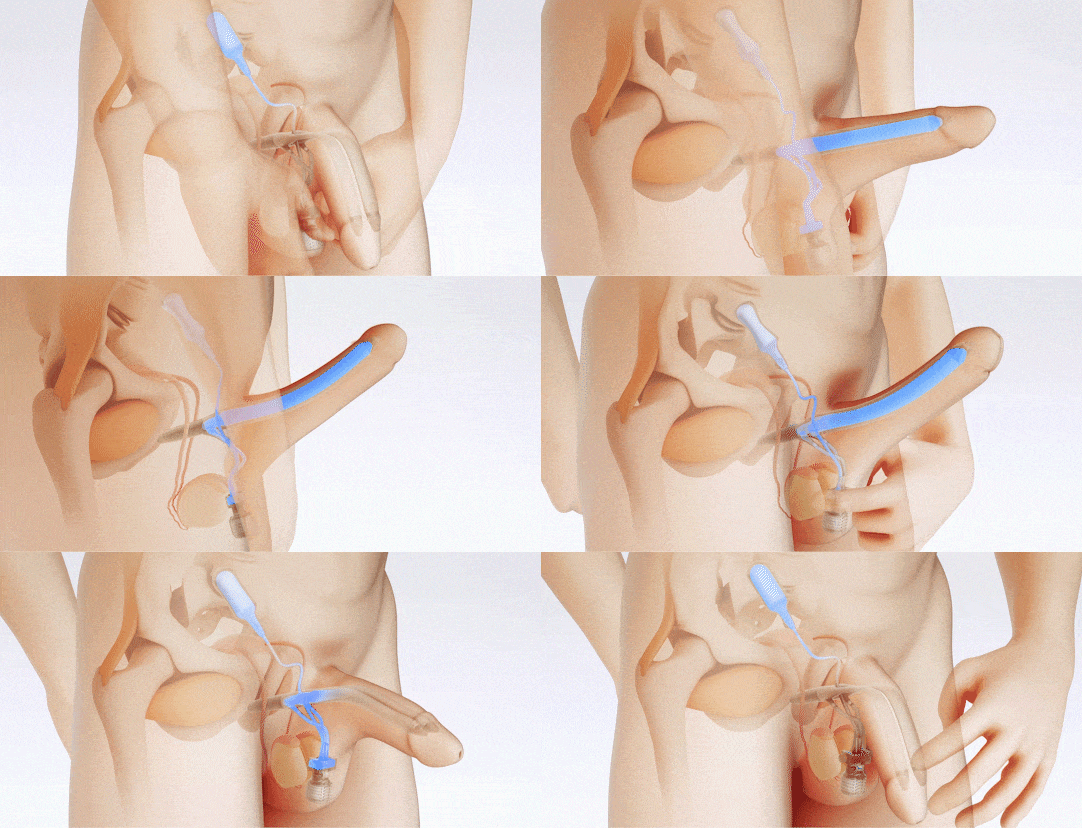
For most international patients, this activation is guided remotely rather than through an in-person visit. The team walks the patient through the activation step by step over video or messaging, depending on the case. The patient is taught to first fully deflate the implant by gently pressing the release area of the pump, and then to inflate it by squeezing the pump in the scrotum until the cylinders fill and the penis becomes erect. The sequence is repeated until the movement starts to feel familiar.
The first attempt at activation is rarely smooth, and patients should expect this. Locating the pump, applying the right pressure, and coordinating the deflate-then-inflate sequence usually feels awkward on the first try. Roughly 98% of patients succeed in activating the device within the first 24 hours of guided practice, and the small number who need additional support typically resolve the difficulty during a brief follow-up call with the team. An in-person visit is reserved for the rare situations, around 2% of cases, where the patient is unable to comfortably operate the pump after remote guidance.
This early activation is a training period, not a green light for sexual activity. The patient practices daily inflation and deflation for short periods during weeks four and five, which softens the surrounding tissue, prevents capsule tightening, and builds full confidence with the system. By the end of week six, the patient is fully familiar with operating the device and ready for the first intercourse experience, which remains postponed until the full six-week window is complete.
When a Malleable Implant Becomes Part of Daily Routine
Malleable patients do not need any activation step. The device has been functional since surgery, and what happens during weeks four to six is psychological more than mechanical.
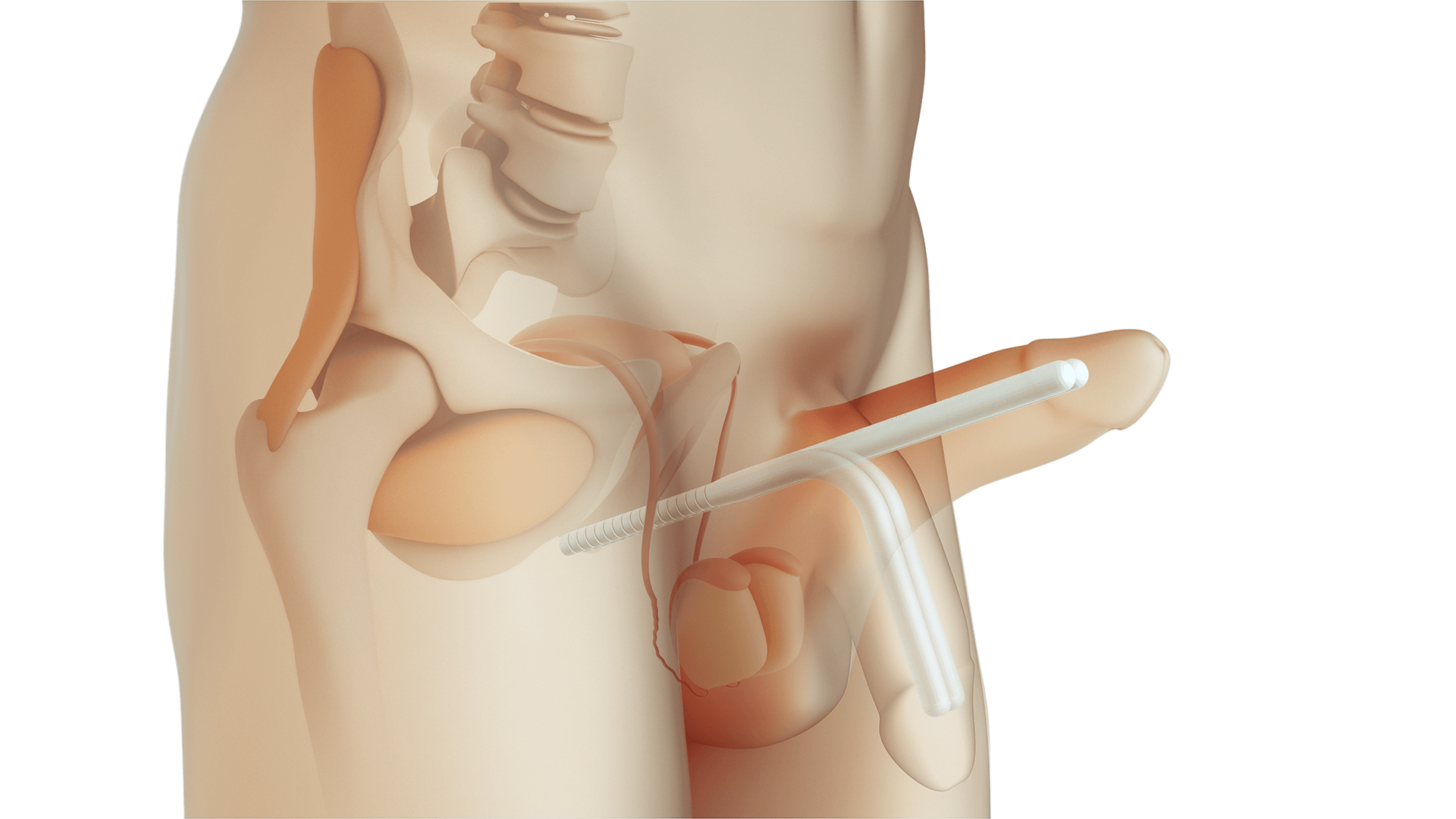
The patient begins to handle the penis more naturally, positioning it upward when needed and downward for daily life, and the movement that felt deliberate during the first weeks starts to feel automatic. By the end of week six, most patients describe it as a habit they no longer think about, similar to the way someone stops noticing eyeglasses after wearing them for a while.
The First Intercourse: What Patients Actually Tell Us
The first attempt is rarely what patients expect. Most arrive at this moment with a mix of anticipation and nervousness, and the most common feedback we hear afterward is that it was easier than imagined.
The erection is reliable, the body responds, and the years of failed medications and uncertain performance fall away in a single experience. Some patients are surprised by the firmness, others by how natural the sensation feels around an artificial device, and a small number need a second or third attempt before the body fully relaxes into the new reality.
Mild discomfort during the very first intercourse is also common and entirely normal. The surrounding tissue has not been used in this way for a long time, sometimes years, and brief soreness during the first week of regular intimacy typically resolves on its own as the body adapts. None of this is unusual, and our team prepares every couple for the fact that confidence builds across multiple experiences rather than arriving complete on the first night.
Once the patient is back to full activity and intercourse has resumed, the visible recovery is essentially over. What continues beneath the surface is a slower, less obvious phase that quietly shapes the long-term result. During months two to six, the body forms a stable fibrous capsule around the implant, surrounding tissue softens, and the final penile length stabilizes. Patients with pre-operative fibrosis or longstanding erectile dysfunction may also notice gradual improvement in tissue elasticity as regular implant use restores blood flow patterns that had been absent for years.

What the patient experiences during this period is mostly subtle. The implant starts feeling less like a device and more like part of the body. Inflation becomes faster and smoother, and most men describe fuller, more natural sensation by month three or four compared to the early weeks. Couples report that intimacy regains spontaneity, and the implant moves from being the focus of intimacy to being invisible inside it. International urology guidelines also emphasize that satisfaction depends not only on surgery, but on correct patient selection, counselling, and follow-up, which is consistent with what we see in our long-term outcomes.
Penile implant surgery affects two people, even if only one of them is in the operating room. The partner is part of the recovery in ways the medical literature rarely discusses, and ignoring this dimension is one of the reasons some couples find the first weeks harder than the surgery itself. During the early recovery, the partner’s role is mostly practical. Helping with positioning at night, managing medication schedules, taking over physical tasks like lifting and shopping, and providing emotional steadiness during moments when the patient feels frustrated by the slow pace of healing.

The second layer is intimacy itself, and it begins much earlier than intercourse. Couples who maintain physical closeness during the four to six week window through holding, kissing, and non-intercourse intimacy almost always describe the eventual first intercourse as easier and more natural than those who treat the recovery as a complete pause.
Some partners are also nervous about hurting the patient or unsure how the implant will change the experience, and these unspoken concerns can carry into the first attempts if not discussed beforehand. Our team encourages couples to talk through these questions openly, because the patients who arrive at activation with their partner involved in the conversation consistently report smoother adaptation in the months that follow.