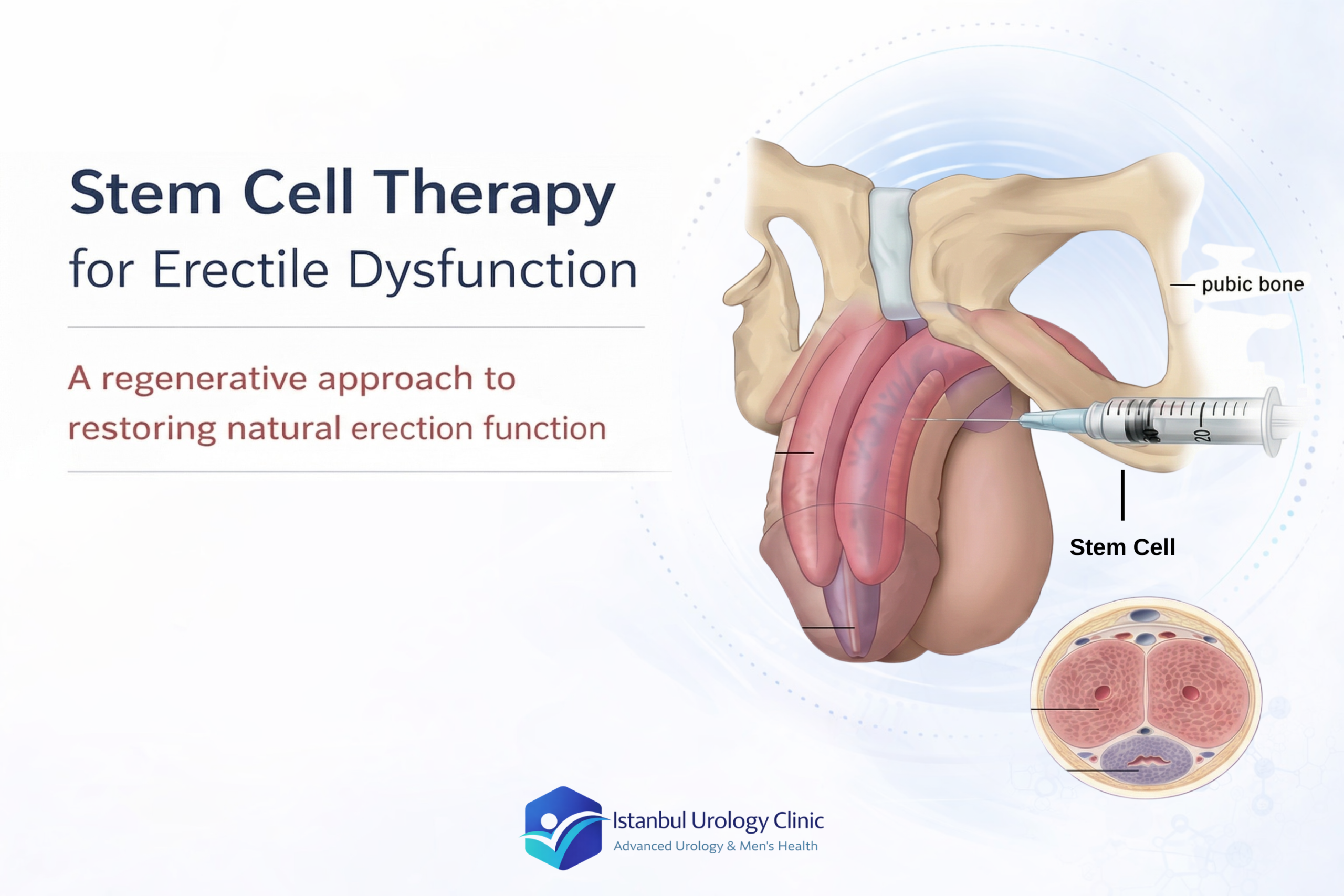
If you are reading this, you have probably already tried the pills. They worked for a while, or they worked occasionally, or they never quite worked the way the prescription promised. Surgery feels like a step too far for where you are right now. What you are looking for is the option that sits in between, and that is where stem cell injection for erectile dysfunction usually enters the conversation.
What you may not realise when you start researching is that stem cell therapy is rarely used as a standalone treatment in serious clinics. At Istanbul Urology Clinic, we use it as one part of the Androskill Regenerative Protocol, a structured combination of stem cell therapy, platelet-rich plasma, and low-intensity shockwave therapy built for men whose erectile function is weakening but has not collapsed. The reason for combining these three is simple. Each one corrects a different piece of the problem, and used together they produce a stronger and more durable result than any of them used alone.
This guide is written for the patient sitting where you are sitting. We will explain how stem cell injection actually works inside the body, who responds well to it and who does not, what the Androskill Protocol looks like across the treatment day and the months that follow, and where this path stops making sense and another approach becomes the right answer. Nothing here is theoretical. It is drawn from the cases we evaluate and treat every week in our clinic in Istanbul.
- How Stem Cell Injection for Erectile Dysfunction Actually Works
- The Androskill Regenerative Protocol: Why We Don't Use Stem Cells Alone
- The Three Stem Cell Sources We Use
- Stem Cell vs PRP: What Actually Differs
- Who Is Actually a Good Candidate for Stem Cell Injection
- What Stem Cell Therapy Cannot Do (Honest Limitations)
- What the Treatment Day Looks Like
- Realistic Recovery Timeline: Week 1 to Month 6
- When Stem Cell Injection Wins vs When Another Path Wins
- A Real Case from Our Practice: Age 48, Mild Arterial Insufficiency
- The Bottom Line
- How Stem Cell Injection for Erectile Dysfunction Actually Works
- The Androskill Regenerative Protocol: Why We Don't Use Stem Cells Alone
- The Three Stem Cell Sources We Use
- Stem Cell vs PRP: What Actually Differs
- Who Is Actually a Good Candidate for Stem Cell Injection
- What Stem Cell Therapy Cannot Do (Honest Limitations)
- What the Treatment Day Looks Like
- Realistic Recovery Timeline: Week 1 to Month 6
- When Stem Cell Injection Wins vs When Another Path Wins
- A Real Case from Our Practice: Age 48, Mild Arterial Insufficiency
- The Bottom Line
Key Points
- Stem cell injection for erectile dysfunction works by supporting tissue regeneration inside the penis, not by forcing an erection the way medication does.
- It performs best in men with mild to moderate ED who still have some natural erectile function and no advanced vascular damage.
- We rarely use it alone. Inside the Androskill Regenerative Protocol it is paired with platelet-rich plasma and shockwave therapy, because each treats a different layer of the problem.
- Improvements develop gradually over three to six months as the tissue responds, not within hours like a pill.
- Candidacy is decided by a penile Doppler ultrasound, not by symptoms alone. Without measuring blood flow, the wrong patient gets the wrong treatment.
- For men with severe vascular disease, advanced venous leakage, or significant structural damage, a penile implant remains the more predictable long-term solution.
How Stem Cell Injection for Erectile Dysfunction Actually Works
An erection is a vascular event. When you become aroused, your brain sends a signal that opens the arteries inside the penis, blood rushes into two spongy chambers called the corpora cavernosa, and a tough outer layer compresses the veins so the blood stays trapped. If any part of that chain weakens, the erection weakens with it. Most cases of ED that we evaluate in mild and moderate patients come down to the same underlying issue: the small blood vessels and the tissue around them are no longer healthy enough to do their job consistently.
Stem cells are the cells your body uses to repair itself. When we inject them into the penile tissue, they release growth factors that trigger three things at once. New micro-blood vessels begin to form, the existing vessels improve their function, and the smooth muscle that controls erection responsiveness recovers some of its lost capacity. None of this happens overnight. The cells start working immediately, but the structural changes they produce build up over weeks and months.
This is why stem cell injection for erectile dysfunction works differently from medication. A pill forces a single erection by widening blood vessels for a few hours. Stem cell therapy aims at the cause of the weakness itself, so that erections improve naturally over time and with less dependence on medication. The trade-off is patience. You will not feel a change the next morning. You may feel it by week six, more clearly by month three, and most fully by month six.
The biological timeline is not a marketing claim. A 2025 systematic review and meta-analysis published in BMC Urology, registered with PROSPERO and covering eleven clinical trials, found measurable improvements in IIEF-5 scores, erectile hardness scores, and peak systolic velocity on Doppler at the six-month mark following intracavernosal stem cell injection. The improvement curve in real practice matches that finding closely. Patients who measure their response on a calendar of weeks are disappointed. Patients who measure it across months see the change.
The Androskill Regenerative Protocol: Why We Don't Use Stem Cells Alone
Most international patients who arrive at our clinic asking about stem cell therapy have already read a dozen pages online presenting it as a single miracle injection. The reality is more useful than the marketing. Stem cell therapy is one of three tools we combine in a structured protocol called Androskill, designed specifically for men with mild to moderate erectile dysfunction. The reason for combining the three is straightforward. Each one targets a different layer of the tissue problem, and used together they reach further than any of them alone.
The protocol is built around the way regeneration actually happens in the body. First, you need a healing environment. Second, you need cells capable of rebuilding tissue. Third, you need a vascular response that delivers oxygen and nutrients to the area while the repair is underway. Each of the three components in Androskill handles one of those layers.
Platelet-Rich Plasma (PRP)
Prepared from your own blood. The platelets are concentrated and reinjected into the penile tissue, where they release growth factors that prepare a healing environment. PRP does not build new tissue. Its role is to make the area receptive to the work the stem cells will do next.
Stem Cell Injection
The regenerative engine of the protocol. Stem cells are introduced into the prepared tissue, where they trigger the formation of new micro-blood vessels, improve existing vessel function, and support the recovery of smooth muscle. This is where the structural change happens.
Low-Intensity Shockwave Therapy (EWST)
Soft acoustic waves applied to the penis stimulate new blood vessel formation and improve circulation in the treated area. Shockwave amplifies and extends the vascular response the stem cells initiated, so the regeneration carries further over time.
Used in sequence and with proper spacing between sessions, this combination produces results that single-therapy protocols rarely match. Stem cell therapy alone can deliver improvement, but in our experience the combined Androskill approach consistently outperforms isolated stem cell injection in mild to moderate cases. This is also the reason we hesitate to offer stem cell injection for erectile dysfunction as a standalone service. When a patient is a candidate for regenerative therapy at all, he is almost always a better candidate for the full protocol.
The Three Stem Cell Sources We Use
Stem cells for ED treatment can come from three different sources, and the choice is not cosmetic. Each source behaves differently inside the body, requires different preparation, and suits a different patient profile. The right source for you depends on your age, your vascular health, what your Doppler scan shows, and how soon you want to begin treatment.
| Source | Best Suited For | Advantage | Planning Required |
|---|---|---|---|
| Fat-Derived (Autologous) | Younger men, men in good general health, mild to moderate ED with no advanced vascular disease | Taken from your own body fat. No donor matching required. Strong regenerative capacity in healthy patients. | Same-visit possible. Fat is harvested under local anesthesia on the same day. |
| Placenta-Derived (Donor) | Patients whose own tissue may be less regeneratively active, often due to age or chronic conditions | Rich in growth factors and signaling molecules. Sourced from pre-screened, healthy donors. | Must be ordered in advance. Treatment day is scheduled around material availability. |
| Donor Mesenchymal Stem Cells (MSC) | Selected cases where high-purity cells are clinically preferred | Imported from certified European laboratories. Each batch verified for sterility, viability, and concentration before use. | Pre-ordered. Lead time depends on laboratory shipping and quality verification. |
The decision is made during your initial consultation, after the Doppler ultrasound and a full medical review. We do not default to one source for every patient. A 38-year-old man with mild ED and healthy general circulation usually benefits most from his own fat-derived cells. A 58-year-old man with longer-standing vascular changes often does better with high-purity donor MSCs, where the regenerative material is independent of his own tissue limitations.
Peer-reviewed clinical reviews of stem cell therapy for ED consistently identify source selection and patient profile as two of the strongest predictors of outcome. This is why the match between source and patient is one of the reasons stem cell injection for erectile dysfunction produces different results across different clinics, even when the procedure name on the invoice looks identical.
Stem Cell vs PRP: What Actually Differs
Patients often arrive asking whether they should choose stem cell therapy or PRP, as if the two are competing options. They are not. They work through different biological mechanisms, they correct different layers of the problem, and in serious regenerative practice they are usually used together rather than instead of each other. Understanding what each one does makes the protocol logic clearer.
| PRP (Platelet-Rich Plasma) | Stem Cell Injection | |
|---|---|---|
| What it does | Releases growth factors that support existing cells | Builds new tissue and new micro-blood vessels |
| Source | Your own blood, processed on the day of treatment | Your own fat, donor placenta, or laboratory-prepared MSCs |
| Effect on tissue | Stimulates and supports, does not regenerate | Regenerates, supports structural recovery |
| Strongest in | Early-stage ED, mild cases, tissue still largely healthy | Mild to moderate ED, tissue with measurable but reversible damage |
| Standalone use | Possible, but limited durability | Possible, but underperforms when used alone |
| Combined use | The combination is the point. PRP prepares the ground, stem cells do the building. | |
The clinics that frame PRP and stem cell therapy as alternatives are usually selling one of them as a packaged product. In actual regenerative practice the question is not which one wins, but how they fit together inside a protocol that produces a measurable response. This is the logic behind Androskill, and it is also the reason single-injection stem cell offerings rarely deliver the results patients are expecting from them.
Who Is Actually a Good Candidate for Stem Cell Injection
This is the question that decides everything, and it is also the question most clinics avoid answering honestly. Stem cell injection for erectile dysfunction is not a treatment for every man with ED. It is a treatment for a specific patient profile, and the wrong candidate in the right chair gets a result that disappoints everyone.
The way we sort this out is not through symptom interpretation alone. It is through a penile Doppler ultrasound, which measures exactly how the blood is moving inside the penile arteries and how well it is being held in place. Without that measurement, candidacy is guesswork.
Patients Who Tend to Respond Well to Stem Cell Injection for Erectile Dysfunction
- Men with mild to moderate ED whose erections still happen but have weakened over the past one to three years
- Patients whose oral medication still works partially but is no longer producing consistent results
- Cases where the Doppler scan shows early vascular changes without advanced damage
- Men who maintain reasonably preserved morning or spontaneous erections
- Patients with no major fibrosis, no significant venous leakage, and no long-standing diabetic vascular damage
- Men in their thirties, forties, and early fifties whose general vascular health is still working in their favor
Patients Who Will Not Benefit and Should Consider Another Path
- Severe ED with little to no spontaneous erectile function remaining
- Advanced venous leakage confirmed on Doppler, where blood escapes the penis faster than regenerative therapy can correct
- Long-standing, poorly controlled diabetes with established vascular damage
- Post-prostatectomy patients beyond the rehabilitation window where nerve recovery is unlikely
- Significant fibrosis or structural penile changes that the tissue cannot regenerate around
- Patients hoping for a one-session permanent solution rather than a multi-session protocol with a recovery timeline
We do not recommend stem cell injection without a Doppler scan first, regardless of how much the patient wants to skip it. If your case has not been measured, the recommendation you receive is not a clinical recommendation. It is a guess. For men whose pattern fits venous leakage, the Doppler often shows that regenerative therapy is the wrong direction entirely, and that another path will give them the result they are actually looking for. You can read more about how this test works in our complete guide to penile Doppler ultrasound.
What Stem Cell Therapy Cannot Do (Honest Limitations)
The reason patients fly to a clinic that says these things out loud is that almost no one writing online about regenerative therapy will. We see the cost of that silence every week. Men arrive after spending years on stem cell sessions at other clinics, hoping each round will be the one that works, when the underlying condition was always outside what stem cell therapy can correct. Knowing where the treatment stops is just as useful as knowing where it works.
- It cannot reverse severe structural damage. If the tissue inside the penis has been scarred or fibrosed beyond a certain point, stem cells do not have anything to rebuild from. Regeneration requires a tissue baseline that can respond.
- It cannot fix advanced venous leakage. When the vein-trapping mechanism inside the penis has failed mechanically, no amount of cellular regeneration will reseal it. This is one of the most common reasons stem cell therapy disappoints. The treatment did its job. The mechanism was the wrong target. If your symptoms match the pattern of venous leakage, the right path looks completely different from regenerative therapy.”
- It cannot replace nerve function that has already been lost. In post-prostatectomy cases beyond the recovery window, where the nerves controlling erection have been permanently damaged, stem cell injection for erectile dysfunction will not restore signal transmission. Nerves do not regenerate the way blood vessels do.
- It cannot produce a permanent, on-demand erection. Even in the best responders, the outcome is improved natural function, not the mechanical certainty of a penile implant. For men whose lives demand reliability over partial improvement, the honest conversation about which option fits their situation matters more than the appeal of the less invasive label.
- It cannot work in a single session for established cases. The biology takes months to respond. A man expecting a same-day result will leave disappointed, regardless of how well the procedure was performed.
According to the International Society for Sexual Medicine, current evidence on regenerative therapies for ED points toward careful patient selection and combined-modality protocols over single-injection approaches. That position reflects what we see in our own caseload. The men who finish the Androskill Protocol satisfied are not the ones with the most enthusiasm at the start. They are the ones whose Doppler findings and clinical picture matched the working range of the treatment before any injection was given.
None of this is meant to discourage you. If your case is a fit, stem cell therapy delivered inside a proper protocol can produce a real and durable improvement. What we want you to leave this section knowing is that the treatment has a defined working range, and that staying inside that range is what separates men who finish the protocol satisfied from men who finish it wondering what went wrong.
What the Treatment Day Looks Like
For international patients flying to Istanbul, the treatment day is a single coordinated visit. The procedure itself takes a few hours, but the planning around it begins weeks in advance to make sure your case has been properly evaluated and the right stem cell source has been prepared and verified. The flow below is what most patients on the Androskill Protocol experience, with small variations depending on the source we are using and the components scheduled for that visit.
Arrival and Final Assessment
You arrive in the morning. Prof. Dr. Onuk reviews your Doppler findings, hormonal panel, and medical history one final time with you. Any last questions are answered before consent is signed. Treatment does not begin until both of you are aligned on what is planned.
Source Preparation
If you are receiving fat-derived cells, a small amount of body fat is harvested under local anesthesia and processed in a sterile preparation unit on site. If donor placental or MSC material is being used, the pre-shipped, pre-verified material is opened and prepared. PRP is drawn at this stage and processed in parallel.
Injection Phase
The prepared material is injected into the penile tissue under local anesthesia. The needles used are very fine, and most patients describe the sensation as a brief pressure rather than pain. The injection itself takes around fifteen to twenty minutes.
Shockwave Component
If shockwave therapy is included in your protocol session that day, the soft acoustic wave application follows the injection phase. This component is painless, takes around twenty minutes, and requires no anesthesia.
Discharge and Same-Day Recovery
You rest briefly before being discharged. There is no overnight stay required. Most patients return to their hotel within an hour of the procedure ending, and normal activity resumes the same day. Mild tenderness or temporary swelling at the injection site is common and settles within forty-eight hours without medication.
Aftercare is structured. You are asked to avoid sexual activity and strenuous exercise for the first seven days, to drink water consistently, and to stay reasonably active with daily walking to support circulation while the tissue begins responding. Most international patients fly home within two to three days of the procedure, with follow-up handled remotely thereafter.
Realistic Recovery Timeline: Week 1 to Month 6
The most common reason patients become disappointed with regenerative therapy is not the treatment itself. It is the expectation that change should arrive quickly. Stem cell injection works on biological time, not pharmaceutical time. Below is what improvement actually looks like across the months following the procedure, drawn from the patients we follow up with after their treatment in Istanbul.
The Settling Phase
Mild tenderness or minor swelling at the injection site is common during the first two to three days and resolves on its own. There is no visible change in erectile function during this period, and there should not be. The injected material is beginning its work at the cellular level, well below the threshold of what you can feel. Sexual activity is paused for the full first week.
Early Tissue Response
Most patients notice nothing during this window. A small subset reports a gradual change in the firmness or duration of spontaneous erections by week four to six, often described as a return of something that had been quietly fading. If you feel nothing yet, that is normal. The structural changes inside the tissue are still developing.
First Measurable Improvement
This is typically the window where stem cell injection for erectile dysfunction begins producing the changes patients came for. Erections become more reliable, response to arousal is faster, and many men find that the medications they were depending on either work better at lower doses or are no longer needed in some encounters. Improvement is rarely a single moment. It accumulates across weeks.
Peak Response and Stabilization
By the end of month four, most responders have reached the bulk of the improvement they are going to see. Some continue to gain incrementally through month six. This is the point at which we re-evaluate with you, ideally with a follow-up Doppler scan, and decide whether a maintenance session is appropriate or whether the result is stable enough to leave alone.
Maintenance
For most patients, the improvement gained during the first six months holds well beyond that, provided the underlying vascular and lifestyle factors are managed. Some men benefit from a maintenance session at twelve to eighteen months. Others never need another. The decision is made based on your follow-up findings, not on a calendar.
When Stem Cell Injection Wins vs When Another Path Wins
This is the comparison that matters more than any other. The question is not whether stem cell therapy is good or bad in absolute terms. The question is whether your specific case fits the working range of the treatment, or whether a different path will give you a better outcome with less wasted time. Below is how we frame that decision with patients during the initial consultation.
Stem Cell Injection Wins When
Your case fits the working range of regenerative therapy
- ED is mild to moderate and has developed gradually rather than suddenly
- Doppler shows early vascular changes without advanced damage
- Oral medication still works partially, even if inconsistently
- Morning or spontaneous erections are weaker but still occurring
- You have time for a three to six month response curve and are not seeking same-day reliability
- You want to delay or avoid penile implant surgery while a regenerative option is still realistic
Another Path Wins When
Stem cell will not reach the cause of your problem
- Doppler confirms advanced venous leakage, the right path is usually venous leakage treatment
- ED is severe, long-standing, and unresponsive to medication, the right path is usually a penile implant
- Diabetes is poorly controlled with established vascular damage
- You need a permanent, on-demand mechanical solution rather than gradual biological improvement
- The Doppler scan has not been done yet, the right next step is penile Doppler ultrasound before any treatment
- You have already completed multiple stem cell rounds elsewhere without measurable response
The right path is the one that matches the cause of your specific ED, not the one that sounds the most attractive on a clinic website. In our practice, we send patients home from the stem cell consultation with a different recommendation roughly as often as we confirm them as candidates. That is not a failure of the treatment. That is what proper candidacy filtering looks like.
A Real Case from Our Practice: Age 48, Mild Arterial Insufficiency
A 48-year-old patient contacted us from the Netherlands after two years of progressively declining erectile function. He had diet-controlled borderline hypertension and a family history of cardiovascular disease. Oral medication had moved from working every time to working roughly half the time over eighteen months. He was not ready for an implant, but he was no longer willing to keep raising his Cialis dose hoping for a different result.
The penile Doppler ultrasound showed mild arterial insufficiency: peak systolic velocity averaged 28 cm/s bilaterally, just below the 30 cm/s normal threshold, with preserved venous function and no leakage. His IIEF-5 on intake was 13. Testosterone sat at the lower end of normal at 380 ng/dL. The clinical picture pointed to early vascular ED with a hormonal component worth supporting in parallel.
We recommended the full Androskill Protocol with fat-derived stem cells, chosen because his general vascular health was still strong enough for his own tissue to deliver a robust regenerative response. He completed the protocol over five days in Istanbul, alongside a separate program addressing his blood pressure and lifestyle factors.
By month three, his IIEF-5 had moved from 13 to 19. At his six-month follow-up Doppler, peak systolic velocity had improved to 34 cm/s bilaterally, back inside the normal range. His IIEF-5 reached 23. He had stopped using oral medication for spontaneous activity, keeping one dose available for occasions where he wanted the extra certainty.
This is the patient profile stem cell injection for erectile dysfunction is built to help. Early enough that the tissue could still respond. Clear enough on Doppler that the recommendation was anchored in numbers. The cases that do not fit this picture are the ones we redirect before any injection is given.
Frequently Asked Questions
It depends on why Viagra stopped working. If the underlying cause is gradual vascular weakening and your Doppler shows early changes without advanced damage, stem cell therapy inside the Androskill Protocol can restore enough tissue function that medication often starts working again, sometimes at lower doses, sometimes not needed at all. If Viagra stopped working because of advanced venous leakage, severe arterial disease, or long-standing diabetic damage, no amount of regenerative therapy will change that. This is exactly why we do not recommend stem cell injection without a Doppler scan first. The reason the pills failed determines whether the regenerative path will succeed.
For mild, early venous insufficiency that is still in a reversible window, regenerative therapy combined with PRP and shockwave can produce meaningful improvement in some patients. For established venous leakage where the vein-trapping mechanism has failed mechanically, the honest answer is no. Cellular regeneration does not rebuild a failed compression seal. Men in this category often spend years on repeated stem cell sessions hoping the next round will work, when the actual path for their problem is a different treatment entirely. The Doppler ultrasound is what separates the two situations, and we run it before any recommendation.
The decision is rarely made on symptoms alone. It is made on Doppler findings, the duration and severity of your ED, how your tissue is responding to current medication, and how reliable a result you actually need. A patient with mild to moderate ED, partial medication response, and early Doppler changes is almost always a stem cell candidate first. A patient with severe ED, advanced vascular damage on Doppler, established venous leakage, or long-standing failure of every non-surgical option is almost always an implant candidate. The gap between the two is where the consultation matters. In our practice, we send men home from the stem cell consultation with an implant recommendation roughly as often as we confirm them as regenerative candidates. The honest conversation is what gets the right outcome.
We look for specific findings. Peak systolic velocity at or near the normal threshold rather than severely reduced. Either normal venous function or only early, partial venous insufficiency, not advanced leakage. No significant fibrosis. No structural damage to the corpora cavernosa. A resistive index suggesting the vascular system can still respond. If the Doppler shows advanced damage in any of these areas, regenerative therapy is the wrong tool for your case, and we say so directly. If the Doppler shows the early-stage picture, stem cell injection for erectile dysfunction has a real chance of producing the improvement you came for.
Each one corrects a different layer of the problem. PRP supports existing cells and prepares the tissue. Stem cells build new micro-blood vessels and support structural recovery. Shockwave therapy improves circulation and extends the vascular response. We combine all three in the Androskill Protocol because used together they reach further than any of them used alone.
Most patients begin to feel a change between weeks four and six, with clearer improvement at months two to three, and the bulk of the response by months four to six. If you feel nothing in the first month, that is normal. Stem cell injection for erectile dysfunction works on biological time, not on the timeline of a pill.
For most responders, the improvement gained during the first six months holds well beyond that, provided the underlying vascular health and lifestyle factors are reasonably managed. Some patients benefit from a maintenance session at twelve to eighteen months. Others never need one. The decision is based on follow-up findings, not on a fixed schedule.
Generally no. Severe ED with advanced vascular damage, established venous leakage, or significant fibrosis is outside the working range of regenerative therapy. In those cases, a penile implant remains the more predictable long-term solution. Honest candidacy filtering is the most important part of the decision.
For the right candidate, yes. It can delay or remove the need for surgery entirely. For the wrong candidate, no, and recommending stem cell injection where an implant is the realistic option only wastes time and money. The Doppler scan is what separates the two situations.
The Bottom Line
Stem cell injection for erectile dysfunction is one of the most valuable regenerative tools available today, but only for the patient profile it was built to help. Used inside the Androskill Protocol alongside PRP and shockwave therapy, in cases of mild to moderate ED with Doppler-confirmed candidacy, it produces real and durable improvement that lets many men delay or avoid surgery entirely. Used outside that working range, it disappoints predictably.
If your case fits the profile, this is a treatment worth considering carefully. If it does not, the most useful thing we can do is tell you so before any injection is given, and point you toward the path that will actually work for you. That conversation begins with a proper diagnosis, which usually means starting with a penile Doppler ultrasound to measure exactly what is happening, before any treatment is recommended.
For a broader picture of how stem cell therapy sits among the full range of options, including non-surgical and surgical paths, see our complete guide to erectile dysfunction treatment options. For men whose evaluation points away from regenerative therapy and toward a definitive solution, the penile implant surgery guide covers what that path involves and who it is for.