The penis is straight now. The surgeon did exactly what was promised. The curvature that bothered him for years is gone. Three months later, the patient is back in the office with a different problem: the straight penis does not work. The surgery succeeded on paper and failed in his bedroom.
This is the scenario that brings most men to the conversation about combined surgery. Not the patient who has just been diagnosed with Peyronie’s disease, and not the patient with early symptoms still trying medications. The patient who arrives at this question has usually already tried something, and what they tried did not deliver what they actually needed.
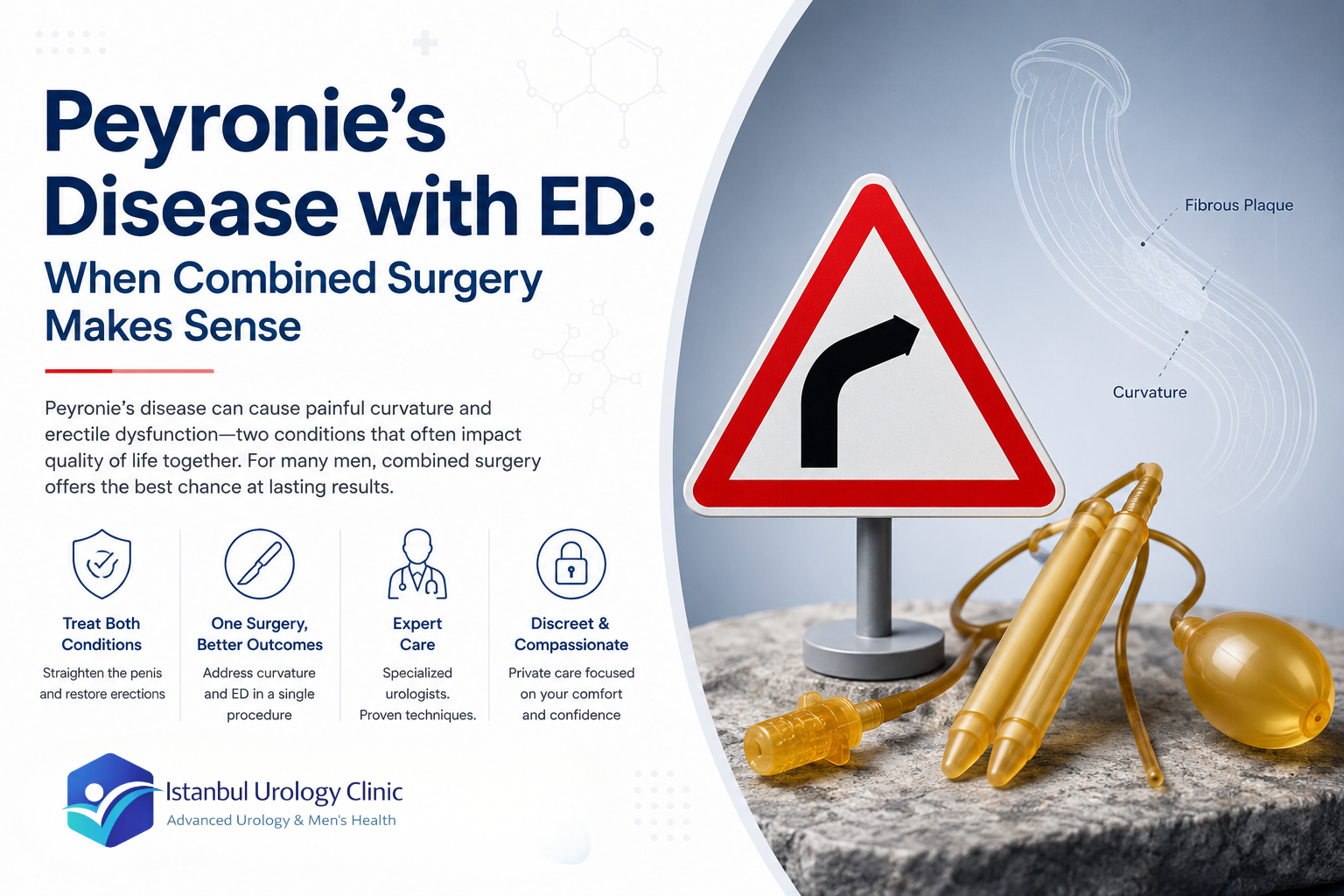
Peyronie’s disease and erectile dysfunction are biologically connected more often than they are separate. The same scar tissue that bends the penis also interferes with the mechanism that produces and maintains an erection. As Peyronie’s advances, erectile function tends to deteriorate alongside the curvature. The two problems converge, and at a certain point treating one without addressing the other no longer produces a useful result.
This guide explains why these two conditions travel together, why treating them separately often fails in advanced cases, when combined surgery becomes the right answer, what the procedure actually involves, who fits this approach, and what outcomes the published data supports. If you are not yet certain your curvature is Peyronie’s specifically, our penile curvature differential guide covers that question first. If you want a fuller view of Peyronie’s disease as a condition independent of the combined scenario, our Peyronie’s disease guide covers phases, causes, and treatment pathways.
- Why Peyronie's Disease and Erectile Dysfunction Travel Together
- Why Treating One Without the Other Doesn't Work
- When Penile Implant Becomes the Right Answer
- What the Combined Surgery Actually Involves
- Who Fits This Approach (And Who Doesn't)
- Realistic Combined-Case Outcomes
- The Decision Most Patients Wrestle With
- The Honest Answer for the Right Patient
- Why Peyronie's Disease and Erectile Dysfunction Travel Together
- Why Treating One Without the Other Doesn't Work
- When Penile Implant Becomes the Right Answer
- What the Combined Surgery Actually Involves
- Who Fits This Approach (And Who Doesn't)
- Realistic Combined-Case Outcomes
- The Decision Most Patients Wrestle With
- The Honest Answer for the Right Patient
Why Peyronie's Disease and Erectile Dysfunction Travel Together
The link between Peyronie’s disease and erectile dysfunction is not coincidental. Both conditions share the same underlying mechanism: scar tissue forming inside the structure of the penis. In Peyronie’s, the scar tissue produces curvature because the affected area cannot stretch during erection. The same scar tissue, when extensive enough, also interferes with the ability of the erectile chambers to fill with blood and maintain pressure during arousal. The result is reduced rigidity, even when blood flow into the penis is otherwise adequate.
Scar tissue inside the tunica albuginea, the outer covering of the penis, affects both the shape of the erection and the rigidity of the erection. The more extensive the fibrosis, the more both functions are compromised at the same time.
The overlap between these two conditions is substantial in the patient populations we see. Erectile dysfunction develops in a significant proportion of men with Peyronie’s disease, particularly in advanced cases or in patients where Peyronie’s has been progressing for years before treatment. The risk is higher when other vascular factors are present, such as diabetes, hypertension, or smoking history, all of which compound the underlying tissue damage.
There is also a psychological loop that worsens both conditions. The visible curvature produces anxiety about appearance and performance. The anxiety contributes to erectile difficulties. The erectile difficulties reinforce the avoidance of intimacy. Over time, what started as a primarily physical condition develops a layer of performance-related dysfunction that persists even when the underlying tissue problem is partially addressed.
Understanding this convergence matters because it changes how treatment is approached. A man with mild Peyronie’s and preserved erectile function has very different needs than a man with advanced Peyronie’s and significant erectile dysfunction. The treatment that works for the first patient is rarely the right answer for the second.
Why Treating One Without the Other Doesn't Work
The most common mistake in advanced Peyronie’s disease with erectile dysfunction is treating the two problems sequentially instead of together. The patient addresses what feels more urgent first, expecting the second problem to either improve on its own or be solved later. In most cases, neither happens. The treatment that addresses one issue often leaves the other one worse than before.
Consider reconstruction alone. A man undergoes plication or grafting surgery to straighten the curvature. The procedure is technically successful. The penis is straight. But the underlying erectile dysfunction, which the surgery did not address, is still present. The result is a straight penis that cannot reliably achieve or maintain an erection. The cosmetic problem is solved. The functional problem is not. Sexual activity remains as difficult as it was before, sometimes more so because the patient had assumed straightening would restore everything.
The reverse scenario is just as common. A man with Peyronie’s and erectile dysfunction starts with PDE5 inhibitors or injections, hoping to manage the erectile component while the curvature stays at its current degree. For a while, this strategy may produce results. But the same fibrosis that bends the penis tends to progress, and as it advances, the erectile mechanism becomes less responsive to medications. The pills stop working. The injections lose their reliability. The curvature, meanwhile, is unchanged or worse. The patient is back where they started, with fewer options.
The third path is delay. The patient hopes one or both problems will improve naturally with time, weight loss, or lifestyle change. Lifestyle improvements help in early disease. They rarely reverse established Peyronie’s with significant fibrosis or restore erectile function once advanced scarring has compromised the erectile mechanism. Waiting often means the patient eventually needs the combined surgery anyway, but with more fibrosis to work with and a longer history of failed attempts behind them.
| Approach | What It Addresses | What It Misses | Typical Outcome |
|---|---|---|---|
| Reconstruction alone | The curvature | The erectile dysfunction | Straight penis that does not function reliably |
| Medications alone | The erectile rigidity, temporarily | The progressing fibrosis | Works at first, fails as the disease advances |
| Delay and wait | Neither | Both problems advance | Eventually requires combined surgery with more fibrosis |
When Penile Implant Becomes the Right Answer
The decision to move to combined surgery is not about reaching a specific threshold of curvature degrees or a particular score on an erectile function questionnaire. It is about recognizing that the clinical picture has shifted from a problem that can be managed in pieces to a problem that requires a single integrated solution. There are four signals that this shift has happened, and most patients who arrive at the combined surgery conversation have several of them at once.
Medication Has Stopped Working
The most common signal is the loss of response to PDE5 inhibitors. The patient who used to get a reliable erection from sildenafil or tadalafil notices that the same dose produces less rigidity, or works inconsistently, or stops working entirely. Switching to higher doses or different medications produces brief improvement before the same pattern returns. This is not a medication failure in the usual sense. It is the underlying tissue losing its ability to respond. Once the erectile chambers can no longer trap blood effectively because of fibrosis, no oral medication will reliably restore rigidity, regardless of dosage.
Injection therapy follows the same trajectory. Alprostadil, Trimix, or other intracavernosal injections may work well at first, sometimes for years. As fibrosis advances, the response becomes less predictable. Erections become less rigid, less durable, or fail to occur even at maximum doses. When both PDE5 inhibitors and injections have lost reliability, the conservative options for erectile dysfunction in this patient are functionally exhausted.
The Doppler Findings Confirm It
A penile Doppler ultrasound often confirms what the patient is already experiencing. The imaging shows poor cavernosal artery flow, venous leak, or both. It identifies the size and calcification status of the plaques. It demonstrates that the erectile tissue itself has been compromised, not just the medication response. When the Doppler shows severe veno-occlusive dysfunction or extensive fibrosis, the question is no longer whether medications will eventually work again. They will not. The question becomes which surgical approach restores the most function with the fewest compromises.
The Curvature Has Crossed a Functional Threshold
The third signal is curvature significant enough to interfere with intercourse independently of the erectile dysfunction. Curves above 30 degrees that produce mechanical difficulty during penetration, hourglass deformities that destabilize the erection, or progressive shortening that has reduced functional length all qualify. A curvature this severe will not be corrected by injection therapy or conservative measures in the stable phase. It needs surgical correction. When erectile dysfunction is also present, performing this correction without addressing the rigidity problem leaves the patient with the same incomplete result described earlier.
The Combined Picture Is Clinically Established
The fourth signal is the convergence of the first three. The medications no longer work. The Doppler confirms structural compromise. The curvature is functionally significant. At this point, current EAU clinical guidance recognizes penile prosthesis implantation with simultaneous curvature correction as the gold standard for advanced Peyronie’s disease with erectile dysfunction, as documented in the EAU Guidelines on Sexual and Reproductive Health. This is not the first-line treatment for Peyronie’s. It is the definitive treatment for the specific subset of patients whose disease has progressed past the point where partial solutions produce useful outcomes.
The honest answer to “when does combined surgery become the right answer” is: when the combination of failing medical therapy, confirmed structural compromise, and functionally significant curvature has converged. Recognizing this convergence is the most important clinical decision in this entire area of urology. Earlier intervention is rarely wrong. Continued delay almost always makes things harder later.
What the Combined Surgery Actually Involves
The combined procedure is one operation that accomplishes two goals: restoring erectile rigidity through implant placement and correcting the curvature through additional techniques performed during the same surgery. The patient undergoes one anesthesia, one recovery period, and one set of follow-up appointments rather than two separate procedures spread across months.
The implant component places a three-piece inflatable penile prosthesis inside the body. Two cylinders sit along the length of the erectile chambers, a pump is positioned in the scrotum, and a small reservoir is placed behind the abdominal wall. The patient activates the device by squeezing the pump, which transfers fluid from the reservoir into the cylinders to produce a rigid erection on demand. The full mechanical details of how the device works are covered in our penile implant surgery guide.
The curvature correction component happens during the same surgery, after the cylinders are placed but before the procedure is completed. The surgeon assesses how much curvature remains once the implant is inflated. Mild residual curvature often corrects on its own as the cylinders expand the corporal bodies during inflation. Moderate curvature is corrected through modeling, a technique that applies controlled pressure to bend the implant against the plaque until the tissue releases and the penis straightens. Severe curvature or complex deformities may require additional plaque incision or grafting to fully restore alignment.
Choosing which technique to use is decided during the operation based on what the surgeon finds once the implant is in place. This is one of the reasons that combined cases benefit from a surgeon experienced specifically in this scenario rather than a general urologist who occasionally performs implant surgery. The judgment calls during the operation determine how much of the residual curvature gets corrected and how durable the result will be.
Who Fits This Approach (And Who Doesn't)
Combined surgery is not the right answer for every man with Peyronie’s disease and erectile dysfunction. The decision depends on disease severity, response to previous treatments, Doppler findings, and the patient’s own goals for sexual function. The three patient profiles below cover the most common scenarios we see in clinic, and where most patients fit themselves once they read the descriptions.
Advanced Disease, Failed Conservative Treatment
Profile: 60s, Peyronie’s diagnosed several years ago, curvature above 45 degrees, PDE5 inhibitors no longer producing useful erections, injections becoming unreliable, Doppler shows severe veno-occlusive dysfunction.
Why combined surgery fits: Conservative options are exhausted. The erectile mechanism cannot be restored to medication-responsive function. The curvature is severe enough that it would need surgical correction even if rigidity were not an issue. One combined operation addresses both problems with predictable outcomes.
Moderate Curvature, Inconsistent Response to Treatment
Profile: 50s, curvature around 30 to 40 degrees, PDE5 inhibitors still work some of the time but not reliably, injections produce results but the patient finds them difficult to commit to long-term, Doppler shows partial venous leak.
Why the decision is harder: The patient is at the transition point. Combined surgery may be appropriate, but a careful Doppler-guided evaluation is needed to confirm that conservative options are genuinely failing rather than being used inconsistently. Some patients in this group benefit from one more structured attempt with optimized medical therapy before committing to surgery. Others have already crossed the threshold and waiting will only mean operating on more fibrosis later.
Mild Curvature, Preserved Erectile Function
Profile: 40s or early 50s, curvature under 30 degrees, PDE5 inhibitors still working well when used, intercourse remains achievable, Doppler shows preserved arterial flow.
Why combined surgery is the wrong answer right now: Implant surgery is irreversible. Once placed, the natural erectile mechanism is bypassed permanently. For a patient whose own erectile tissue is still working, this represents losing function that does not need to be replaced. Plication or grafting alone can correct the curvature without involving the device. Medications continue to manage the erectile component. This patient may eventually become a candidate if the disease advances, but the right answer today is preserving the options he still has.
The Doppler ultrasound is the single most useful test for placing a patient into the correct group. Self-assessment of medication response is unreliable because patients often underestimate how much function has declined. The Doppler shows objectively whether the erectile tissue can still trap blood, whether the cavernosal arteries are delivering adequate flow, and whether the underlying anatomy supports restoration of natural erections or has progressed past that point. Patients who think they are in the borderline group are sometimes in the ideal candidate group once the imaging is reviewed. The reverse is also true.
Realistic Combined-Case Outcomes
The outcomes data for combined penile implant surgery with curvature correction is the strongest in this entire area of urology. Unlike conservative treatments where results vary widely between studies and depend heavily on patient selection, combined surgery produces consistent results across centers, surgeons, and publication years. This consistency is one of the reasons it has become the gold standard for advanced cases.
The satisfaction figures above come from a systematic review published in 2021 that pooled outcomes across 935 patients in 23 studies. The range from 80 to 100 percent reflects variation between individual studies, but every study included in the review reported high satisfaction. No published series of combined surgery has produced poor satisfaction outcomes when performed by experienced surgeons in appropriately selected patients. The procedure is one of the most reliably satisfying operations in urology.
What Combined Surgery Actually Restores
Reliable rigidity on demand is the most direct outcome. The implant produces an erection whenever the patient activates the device, independent of medication, mood, or vascular health. This is a more dependable result than any medical treatment for erectile dysfunction can produce, which is why patient satisfaction tends to exceed satisfaction with PDE5 inhibitors or injections in patients who have used both.
Functional straightening is the second outcome. The curvature is corrected during the same surgery to the degree that produces comfortable intercourse. Mild residual curvature may remain in some cases, particularly when the original deformity was severe, but residual curvature of less than 20 degrees almost never interferes with sexual function and most patients do not notice it after recovery.
Restored intercourse capability is the outcome that matters most to most patients. The studies that have tracked sexual activity rates after combined surgery consistently show return to regular intercourse in the majority of patients, often after years of disrupted or absent sexual activity before the procedure. The psychological impact of this restoration is significant and is one of the strongest reasons patient satisfaction remains high even when length expectations are not fully met.
What Combined Surgery Does Not Restore
Original penile length is the most common limitation. The combined procedure can restore some length lost to fibrosis, particularly when grafting is included, but it cannot return the penis to the exact dimensions the patient had before Peyronie’s began. Patients who measure success by length recovery alone are sometimes disappointed. Patients who measure success by restored function are consistently satisfied.
Spontaneous erections without device activation are also lost. The implant produces rigidity through mechanical inflation, not through the natural blood-trapping mechanism. Sensation, orgasm, and ejaculation remain unchanged, but the spontaneous erection that occurs from arousal alone is no longer part of the experience. For patients whose erectile mechanism was already failing, this is a small trade-off. For patients whose erections were still working without medication, it would be a significant loss, which is why combined surgery is not recommended in that group.
The Decision Most Patients Wrestle With
Most patients who meet the criteria for combined surgery do not move forward immediately. They wait. Sometimes for months, sometimes for years. The reasons are understandable, and they are usually the same across very different men.
The first reason is hope that something else will work. The patient has been trying medical treatments long enough that another attempt feels less daunting than the commitment of surgery. There is usually one more medication adjustment to try, one more injection protocol, one more lifestyle change. Some patients cycle through these for years before accepting that the response is not going to return.
The second reason is fear of the irreversibility. Penile implant surgery cannot be undone. Once the natural erectile tissue is replaced, the patient cannot return to medication-responsive erections later. For a man whose own function has been declining gradually, this finality feels heavier than the gradual loss he has been adapting to. It is easier to keep adapting than to make the decision that closes the door on the previous version of his sexual life.
The third reason is uncertainty about timing. The patient knows the surgery will probably be needed eventually but does not know when. Waiting another year feels safe. Waiting another two years feels safer. There is no clear signal that says “the right moment is now,” because the underlying decline is continuous rather than sudden.
The combined surgery does not become impossible with time. It becomes more complex. Additional fibrosis develops. Length loss continues. The plaques may calcify further. Patients who have surgery earlier in the trajectory have shorter operations, better length preservation, and faster recoveries than patients who have the same surgery five years later. In many patients, earlier evaluation preserves more options than waiting until fibrosis is more advanced.
None of the reasons for delay are wrong. Each one reflects a legitimate concern. But the patients who eventually undergo combined surgery and look back on the decision rarely say they wish they had waited longer. They more often say they wish they had decided sooner. This is not a sales argument. It is the pattern we see in clinic conversations after the operation, when the patient is recovering and the previous years of declining function are clearly visible in retrospect.
Frequently Asked Questions
It is the same base procedure with additional steps. The implant is placed the same way as in any inflatable penile prosthesis surgery. The difference is that the curvature is corrected during the same operation through modeling, plaque incision, or grafting as needed. The complexity depends on how severe the original curvature is and how much fibrosis is present. Operative time is typically longer than a standard implant alone, often by 30 to 60 minutes.
In most cases, yes, to the degree that produces comfortable intercourse. Mild residual curvature under 20 degrees may remain in some patients with severe original deformity, but this rarely interferes with sexual function. The goal is functional straightening rather than cosmetic perfection. Most patients do not notice small residual curves once recovery is complete.
Recovery follows the same general timeline as standard implant surgery. Most patients return to non-strenuous daily activities within one to two weeks. Sexual activity is typically cleared at six weeks after the device is activated. Full tissue adaptation continues for several months. Combined cases sometimes require slightly longer initial recovery if extensive grafting was performed, but the difference is usually small.
Yes. The nerves responsible for sensation, arousal, orgasm, and ejaculation are not affected by the procedure. What changes is the mechanism producing rigidity. The natural blood-trapping mechanism is replaced by the implant, but the experience of arousal and orgasm remains intact. Most patients report that sensation feels normal once recovery is complete.
The combined procedure aims to preserve length rather than reduce it. In some cases, particularly when grafting is included, modest length recovery is possible. The published literature shows mean length increases of around 2 to 3 centimeters in combined cases with grafting techniques. Patients who underwent significant shortening before surgery often see partial recovery of what was lost.
Yes, with appropriate preoperative management. Diabetic patients have higher rates of both Peyronie's disease and erectile dysfunction, which means they are over-represented in the combined surgery population. Glycemic control before and after surgery is important to reduce infection risk and support healing. Most diabetic patients with controlled blood sugar are good candidates.
The combination of failed response to maximum-dose PDE5 inhibitors, declining response to injection therapy, and Doppler findings showing significant veno-occlusive dysfunction or arterial insufficiency is the clinical picture that points to implant. Self-assessment alone is unreliable because patients often underestimate how much function has declined. A structured evaluation with Doppler gives the objective answer.
It is available, but it is rarely the first choice for younger patients. Most men under 50 have at least some preserved erectile mechanism that can be supported with conservative options. Implant surgery is irreversible, and replacing function that is still partially working has long-term implications. Younger patients are usually directed toward reconstructive surgery without an implant unless their erectile function is severely compromised.
Inflatable implants are the standard choice for combined surgery because they produce a more natural erection cycle, allow the penis to remain flaccid when not in use, and provide better modeling capability during surgery to correct the curvature. Malleable implants are simpler and less expensive but produce a permanently semi-rigid penis, which is less ideal in patients undergoing combined correction. For most Peyronie's plus ED cases, three-piece inflatable systems are recommended.
The Honest Answer for the Right Patient
Combined surgery is not the first answer for Peyronie’s disease and erectile dysfunction. It is the definitive answer for the specific subset of patients whose disease has progressed past the point where partial solutions produce useful outcomes. For these patients, the procedure does what no other treatment can do: it restores rigidity reliably, corrects the curvature in the same operation, and gives the patient back the capacity for spontaneous intercourse that has been gradually lost.
The patients who do best with combined surgery are not the ones who acted fastest or the ones who waited the longest. They are the ones who recognized when the clinical picture had shifted, evaluated the options honestly, and chose the path that matched their specific situation. For some men this happens after one or two failed treatments. For others it takes years. What matters is reaching the decision before the disease makes the surgery harder than it needed to be, and before more years of declining function pass without resolution.
If the description in this guide matches your situation, the right next step is a structured evaluation with Doppler imaging that confirms what the clinical picture suggests. From there the decision becomes clearer, and the path forward is no longer about cycling through partial solutions hoping one will finally work.