

If you have diabetes and your erections are not what they were two or five or ten years ago, you already know what you are dealing with. The real question, the one most diabetic men reading this came here to answer, is not whether the problem exists. It is how much of it is still reversible, and how much is already permanent. Diabetes and erectile dysfunction are linked more tightly than almost any other medical pairing in men’s health, and the honest answer to that question depends on where you actually are on the damage curve.
Some men reading this still have a wide window of options. Others have a narrower one. A smaller group has reached the point where the most useful conversation is no longer about pills or shockwave, but about something more definitive. The first job of this guide is to help you figure out which group you are in before you spend another year on a treatment that was never going to work for your stage.
What follows is the same reasoning used across the desk with a diabetic man sitting in a consultation room. What changed in your body, why it changed, where you are now, and what actually works at this point. Not what worked at the start.
- Diabetes and Erectile Dysfunction: Why This Is Not Your Average ED
- How Diabetes and Erectile Dysfunction Connect: The Four Damages
- Where Are You on the Damage Curve?
- What HbA1c, Duration, and Doppler Tell Us About Your Stage
- Why Pills Stop Working in Diabetic Men
- Treatment Matched to Your Stage, Not to a Ladder
- The Middle Path: Regenerative Options When Surgery Feels Too Soon
- Why Glycemic Control Is Treatment, Not Adjunct
- When Diabetes and Erectile Dysfunction Lead to an Implant Conversation
- What Waiting Usually Costs a Diabetic Patient
- Conclusion
- Diabetes and Erectile Dysfunction: Why This Is Not Your Average ED
- How Diabetes and Erectile Dysfunction Connect: The Four Damages
- Where Are You on the Damage Curve?
- What HbA1c, Duration, and Doppler Tell Us About Your Stage
- Why Pills Stop Working in Diabetic Men
- Treatment Matched to Your Stage, Not to a Ladder
- The Middle Path: Regenerative Options When Surgery Feels Too Soon
- Why Glycemic Control Is Treatment, Not Adjunct
- When Diabetes and Erectile Dysfunction Lead to an Implant Conversation
- What Waiting Usually Costs a Diabetic Patient
- Conclusion
Diabetes and Erectile Dysfunction: Why This Is Not Your Average ED
Erectile dysfunction in a diabetic man is not the same condition as erectile dysfunction in a man without diabetes, even when the symptoms look identical from the outside. The mechanism is different, the speed of progression is different, and the response to standard treatments is different. Treating diabetic ED with the same playbook used for non-diabetic ED is one of the most common reasons men spend years on therapies that were never going to deliver durable results.
It starts earlier. Diabetic men develop erection problems on average ten to fifteen years younger than men without diabetes. It progresses faster, because high blood sugar damages multiple systems at the same time rather than one at a time. And it responds less reliably to oral medication, because the same vascular and nerve damage that caused the ED also limits how well pills like Viagra and Cialis can work.
This is why a diabetic patient who walks into our clinic after five years of inconsistent pill response is rarely in the same clinical situation as a non-diabetic patient with the same complaint. The diabetic patient has usually accumulated damage across blood vessels, nerves, and erectile tissue together. The non-diabetic patient often has a single, more isolated cause. The treatment conversation has to reflect that difference from the first consultation, not the third.
How Diabetes and Erectile Dysfunction Connect: The Four Damages
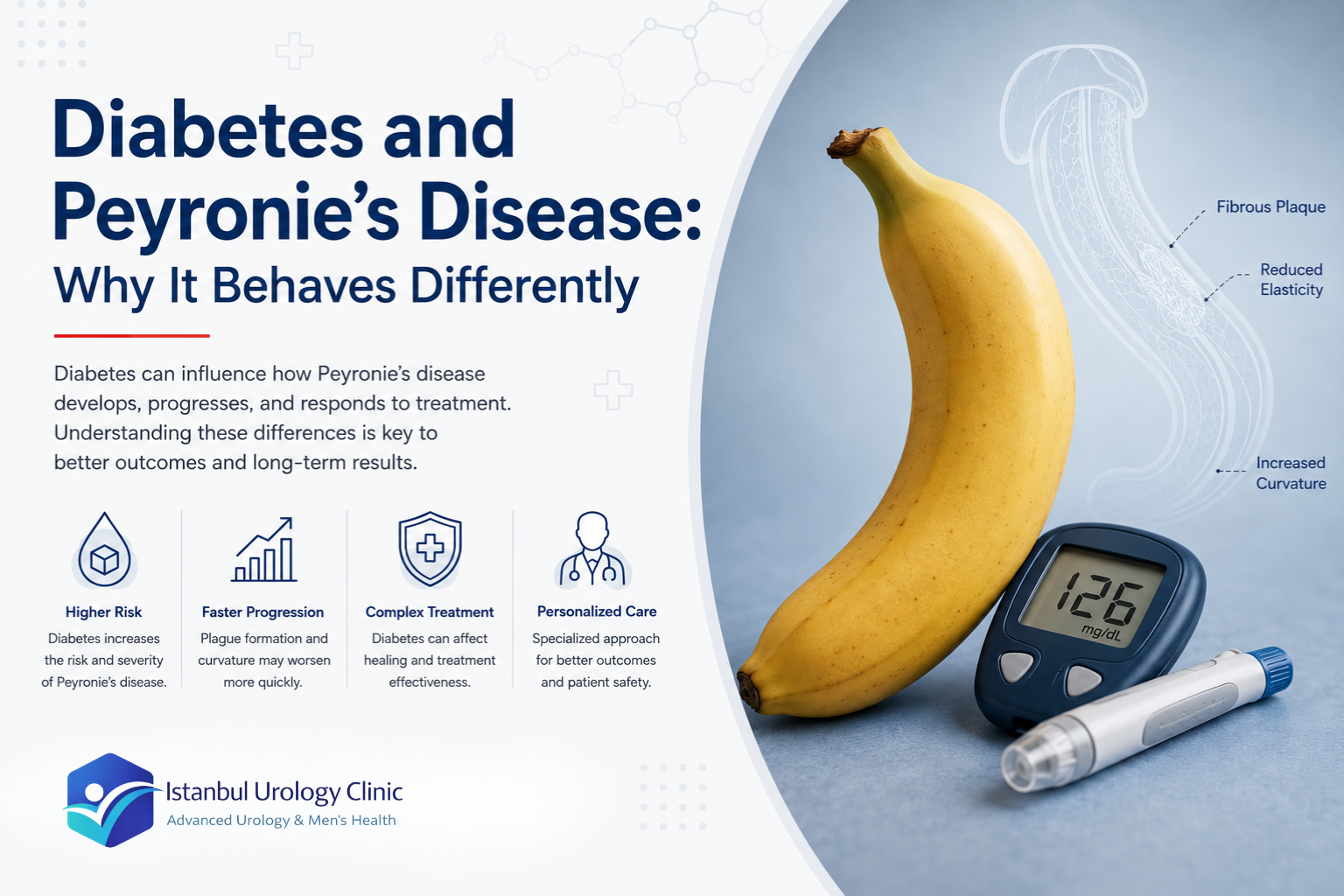
An erection is a coordinated event between blood vessels, nerves, smooth muscle, and hormones. Diabetes attacks all four of these systems, not just one. This is the single most important fact for understanding why diabetic ED behaves differently and why it is harder to reverse the longer it has been present. The four mechanisms below are how the damage actually develops.
The Four Damages Diabetes Does to Erectile Function
| Damage Type | What Diabetes Does | What You Notice |
|---|---|---|
| Damage to small blood vessels | High blood sugar damages the inner lining of arteries throughout the body. The small arteries that bring blood into the penis are among the first affected because they are so narrow. Less blood enters, and the pressure needed for a firm erection is no longer built. | Erections become softer, slower to develop, and harder to maintain. Pills like Viagra may still help at first, then start delivering less. |
| Nerve damage (diabetic neuropathy) | Long-standing high blood sugar damages the nerves that carry the arousal signal from the brain to the penis. The blood vessels may still be partially functional, but the signal telling them to open is now weaker or delayed. | Arousal feels disconnected from the physical response. You may feel mentally engaged while the body fails to follow. Morning erections become less frequent. |
| Smooth muscle fibrosis | Inside the erection chambers, healthy smooth muscle gradually becomes scar tissue when oxygenation drops over years of vascular damage. The chambers lose elasticity and can no longer expand or trap blood the way they used to. | The penis feels less full even when an erection forms. Length may shorten gradually. Injections and pills produce weaker results than they used to. |
| Lower testosterone | Diabetic men have a higher rate of low testosterone than men without diabetes. This is not the main cause of diabetic ED, but it compounds it by reducing libido and slowing the recovery of erectile tissue. | Drop in sexual desire alongside the erection problem. Energy, mood, and morning erections all decline together rather than separately. |
Most diabetic patients have a combination of these four, not just one. The clinical picture in a man who has lived with diabetes for ten or fifteen years is almost always layered. This is also the reason single-treatment approaches stop working: a pill targets blood flow, but it cannot repair nerve damage or reverse smooth muscle fibrosis. For a deeper look at how blood escapes the penis when these chambers can no longer trap it, see the guide to venous leakage and erectile dysfunction.
Where Are You on the Damage Curve?
The most useful question a diabetic patient can ask is not “do I have ED” but “how far along is it.” Diabetic ED is one of the few erectile conditions that progresses on a recognizable curve, and where you are on that curve determines which treatments will still work for you. Most men can place themselves on this curve within five minutes of reading the descriptions below. The timeline is not based on age. It is based on what you are actually experiencing.
If you read those three descriptions and recognized yourself clearly in one of them, you already know more about your case than most men do after five appointments. If you are between two stages, you are probably transitioning, and the direction matters more than the exact label.
Diabetic ED moves in one direction over time unless the underlying disease is brought under control. The next two sections explain how we confirm your stage objectively, and why pills behave differently as you move through it.
What HbA1c, Duration, and Doppler Tell Us About Your Stage
Self-recognition tells you how the body feels. Three objective markers tell you what is actually happening inside it. Together they confirm your stage with much more precision than symptoms alone. Any diabetic patient being properly evaluated for erectile dysfunction should be asked three questions before treatment is discussed: how high has blood sugar been running, how long has diabetes been present, and what does penile blood flow look like under ultrasound.
| Marker | Stage 1: Reversible | Stage 2: Compensated | Stage 3: Decompensated |
|---|---|---|---|
| HbA1c (3-month average blood sugar) | Under 7%, mostly controlled | 7-8.5%, inconsistent control | Above 8.5% or long history of poor control |
| Years living with diabetes | Usually under 5 years | Typically 5-10 years | 10 or more years, often longer |
| Penile Doppler findings | Normal or near-normal blood flow | Reduced arterial inflow, early venous leak | Severely reduced inflow, confirmed venous leak |
| Morning erections | Still present most days | Occasional, weaker than before | Rare or absent |
The Doppler is what removes the guesswork. Symptoms can mislead, especially in diabetic men who have adapted to declining function over years and stopped noticing how far it has shifted. Blood flow measured during a controlled examination shows the real picture. For a full explanation of how this test changes the treatment plan, see the guide to penile Doppler ultrasound for erectile dysfunction.
One detail worth understanding: these three markers do not always move together. A patient can have well-controlled HbA1c today but ten years of poor control behind him. The damage from those earlier years is still there, even if current numbers look reassuring. This is why a Doppler is more diagnostic than any single lab value when staging diabetic ED.
Why Pills Stop Working in Diabetic Men
This is the question almost every diabetic man asks during the first consultation, often before anything else. Viagra or Cialis worked at the start, sometimes for years. Then it became less reliable. Then it stopped working at higher doses too. The pattern is so consistent it is one of the clearest markers of where diabetic ED is heading without intervention. The progression below is the one observed across most diabetic patients, in this order.
Early diabetes, blood sugar well controlled
Pills like Viagra and Cialis work well. The response is close to what a non-diabetic man would experience, and a standard dose is usually enough. This is the stage where oral therapy is most reliable and, paradoxically, most underused.
Five to ten years of diabetes
Response becomes less reliable. Higher doses are often needed. Some attempts work, others fail without an obvious reason. This is the first warning that the underlying vascular damage has started progressing, even when blood sugar numbers still look acceptable on paper.
Diabetic neuropathy begins
Pills now produce only a partial response. The medication still opens the blood vessels, but the nerve signal triggering the erection has become too weak to fully activate it. The chemistry is working. The wiring is not. Increasing the dose stops helping at this point.
Severe vascular damage
Pills fail consistently, regardless of dose or brand. The blood vessels themselves can no longer respond to the chemical signal that pills rely on. Switching between Viagra, Cialis, and Levitra produces the same result for the same reason.
Reading this progression backwards tells you something useful. If pills used to work and now they do not, the question is not which pill to try next. The question is which stage above you are now sitting in. That answer determines whether the next step is injections, a Doppler-guided plan, or a different conversation entirely. Trying a stronger dose of something that has stopped working because the underlying mechanism changed is one of the most common reasons diabetic patients lose years before reaching effective treatment.
Treatment Matched to Your Stage, Not to a Ladder
Most ED content presents treatment as a ladder: start with pills, climb to injections, then shockwave, then surgery. For diabetic ED this framing is misleading. A man in the reversible stage and a man in the decompensated stage are not on the same ladder at different rungs. They are facing different problems, and they need different starting points. The framework below is how the treatment conversation actually unfolds once staging has been confirmed.
| Your Stage | Where Treatment Starts | What a Realistic Result Looks Like |
|---|---|---|
| Stage 1: Reversible | Aggressive glycemic control, lifestyle correction, oral therapy as needed. Shockwave can be added in selected cases where Doppler confirms early vascular changes without severe damage. | Substantial recovery of erectile function is realistic, particularly when blood sugar is brought under sustained control. This is the only stage where reversal, not just management, is a credible goal. |
| Stage 2: Compensated | Optimized oral therapy with proper dosing, daily low-dose tadalafil in selected cases, and a planned escalation to injections if pills no longer deliver consistent results. Glycemic control remains essential. | Reliable function during intercourse when the right combination is found. Reversal of the underlying damage is unlikely, but slowing progression and maintaining function for years is realistic. |
| Stage 3: Decompensated | Honest evaluation of whether continuing non-surgical treatment is producing meaningful results. For most patients in this stage, the conversation shifts toward penile implant surgery as the definitive solution. | With an implant, a reliable erection on demand is achievable independent of vascular and nerve damage. Without it, most men in this stage continue to experience failure regardless of which pill or injection is tried. |
The reason this matters: a Stage 3 patient who keeps trying new pills is not climbing a ladder. He is repeating a failed step. A Stage 1 patient who jumps to injections is not being aggressive about his treatment. He is skipping the part that would have actually helped. Matching the treatment to the stage is what protects patients from both directions. For the full overview of how every ED treatment option fits together across the patient population, see the complete guide to erectile dysfunction treatment.
The Middle Path: Regenerative Options When Surgery Feels Too Soon
Some diabetic patients sit between the stages. Pills are no longer reliable, but the damage is not severe enough for the implant conversation to feel right. The man in this position is usually in Stage 1 or early Stage 2, has either improved his blood sugar recently or is in the process of doing so, and is looking for a treatment that gives the tissue a chance before considering surgery. For carefully selected patients, regenerative therapy can occupy this middle space.
The Androskill Protocol combines PRP injections, stem cell injections, and low-intensity shockwave therapy in sequence. The three approaches aim to support the tissue, stimulate new micro-blood vessel formation, and improve how well the existing erectile structures respond. They do not reverse advanced damage. What they can do, in the right candidate, is delay or sometimes avoid the need for surgical intervention.
The conversation about regenerative therapy in diabetic ED is honest only when four conditions are met together. Anything outside them is overselling.
- ✓ You are in Stage 1 or early Stage 2, not decompensated
- ✓ Your blood sugar is now controlled or actively improving, not still elevated
- ✓ A penile Doppler confirms early vascular changes without established structural damage or significant venous leak
- ✓ You understand the response curve is three to six months of gradual change, not a same-day result
The reason these filters matter: regenerative therapy delivered to a Stage 3 patient with long-standing uncontrolled diabetes does not produce meaningful change. The clinics that promise otherwise are selling hope, not biology. Used inside its narrow working range, the Androskill Protocol can meaningfully improve erectile function in diabetic men who are still inside the reversible or early compensated window. Used outside that range, it disappoints predictably.
If your blood sugar has come under better control in the past year, your morning erections are still present even if weaker, and your Doppler points to early rather than advanced changes, regenerative therapy is worth discussing as the middle path between continuing to chase pills and committing to surgery. The full picture of how the protocol works, who responds well, and what the realistic outcomes are is covered in the guide to stem cell injection for erectile dysfunction.
Why Glycemic Control Is Treatment, Not Adjunct
Most articles list blood sugar control as a “lifestyle recommendation” near the end, alongside diet and exercise. That framing is wrong for diabetic ED. Glycemic control is not a supporting habit. It is the foundation that decides whether anything else you do will hold. A pill, an injection, a shockwave session, even an implant evaluation, all behave differently in a patient whose HbA1c is 6.8 compared to one whose HbA1c is 9.2.
A 2026 review in Translational Andrology and Urology confirms this directly. Strict glycemic control with HbA1c below 7% is identified as the cornerstone of diabetic ED management, and the same review documents a 40 to 50 percent non-response rate to oral medication in diabetic men, driven by the vascular and nerve damage that uncontrolled blood sugar produces over time (Wang et al., 2026).
The reason is mechanical. High blood sugar keeps damaging the same blood vessels, nerves, and erectile tissue that treatment is trying to support. Without halting that damage, every intervention is being applied to tissue still deteriorating underneath it. Diabetic patients who bring their blood sugar under control for six to twelve months often report that their existing oral therapy starts working better, not because the pill changed, but because the tissue it acts on is healthier.
If your diabetes is uncontrolled and you are seeking ED treatment, the first conversation is with your endocrinologist, not with us. Bringing HbA1c into a safer range improves what you are already taking and changes which treatments become realistic if you escalate. Skipping this step and chasing stronger ED medications instead is the most expensive shortcut a diabetic patient can take.
When Diabetes and Erectile Dysfunction Lead to an Implant Conversation
For most diabetic patients, the implant conversation does not come up early. It comes up when the staging has confirmed decompensated damage, oral therapy has stopped working, and injections are either failing or no longer producing results consistent enough to plan a sexual life around.
At that point continuing to chase non-surgical options stops being patient and starts being expensive, both in money and in years lost. The two situations below frame the decision of whether the conversation should shift.
Pills still produce a usable response, even if not always. Injections are working at a tolerable dose. Doppler shows partial vascular function. Blood sugar is improving or already controlled. The treatment plan still has room to deliver, and there is no clinical urgency to move toward surgery.
Pills have stopped working at all doses. Injections produce inconsistent or fading results. Doppler confirms severe vascular damage with venous leak. Years have already been spent cycling through treatments that no longer hold. At this stage the implant becomes the one option that does not depend on vascular or nerve function the diabetes has already damaged.
Beyond the broad picture above, the decision comes down to a specific set of criteria. The implant conversation with a diabetic patient becomes realistic when all or most of the following are true:
- Maximum-dose PDE5 inhibitors no longer produce intercourse-quality erections
- Injections are ineffective, poorly tolerated, or unacceptable to the patient
- Doppler confirms severe arterial insufficiency or venous leak
- The patient wants reliability rather than further treatment escalation
This is the framework rather than a single threshold, because diabetic ED rarely fails one treatment in isolation. When three or four of these criteria are met together, the implant conversation stops being premature and starts being the most honest option on the table. Diabetic patients are one of the most consistent groups in terms of implant satisfaction, because the implant solves the specific problem they have: reliable erections on demand, independent of the blood flow and nerve signaling that diabetes has progressively weakened. The full picture, including device options, recovery, and what the surgery involves, is covered in the complete guide to penile implant surgery.
Diabetic patients are one of the most consistent groups in terms of implant satisfaction, because the implant solves the specific problem they have: reliable erections on demand, independent of the blood flow and nerve signaling that diabetes has progressively weakened. The full picture, including device options, recovery, and what the surgery actually involves, is covered in our complete guide to penile implant surgery in Turkey.
What Waiting Usually Costs a Diabetic Patient
Diabetic ED rarely stays still. The most common reason diabetic men end up with fewer treatment options is not that their disease was unusually aggressive. It is that they spent years on the same prescription, waiting for it to start working again, while the underlying damage continued progressing in the background. Time is the variable most patients underestimate.
The deterioration is not abstract. It follows a recognizable curve in diabetic patients whose blood sugar remains poorly controlled. The progression below reflects the pattern observed clinically across thousands of cases, comparing men who acted early to those who delayed.
- Year 1 of noticing changes. The damage is still mostly functional. Oral therapy works well in most cases. Lifestyle and glycemic correction can produce meaningful improvement. This is the widest window of options and the easiest stage to treat. Most men do not act here, because the symptoms still feel manageable.
- Year 5 without intervention. The first structural changes have begun. Pills work less reliably and may need higher doses. Morning erections become less frequent. Injections enter the conversation. Reversal is no longer the goal. Maintaining function becomes the realistic target. Many men first seek treatment around this point.
- Year 10 without intervention. Smooth muscle fibrosis is now established. Vascular damage is often severe enough to be visible on Doppler. Pills frequently fail entirely. Injections still help in many cases, but the response is weaker. The conversation begins to shift toward whether non-surgical treatment is still the right path.
- Year 15 or more without intervention. Most men in this group have already reached the decompensated stage. Pills no longer work. Injections produce limited results. The realistic options narrow to either continuing with diminishing returns or considering a definitive solution. This is the stage where most diabetic implant patients in our practice arrive, often saying they wish they had acted sooner.
The point is not to alarm. It is to make the cost of waiting visible, because most diabetic patients are never told that the treatment window narrows year by year. Acting in Year 2 is a different conversation from acting in Year 12, even when the symptoms in Year 2 felt mild enough to postpone.
Frequently Asked Questions
In the early stage, partially or substantially yes. When blood sugar is brought under sustained control and the underlying vascular damage is still mostly functional, many diabetic men recover meaningful erectile function. Once structural damage to the erectile tissue and small blood vessels has accumulated, full reversal becomes unlikely. At that point the realistic goal shifts from reversing to maintaining and supporting function. This is why staging matters more in diabetic ED than in most other ED subtypes.
There is no fixed timeline, but the average is faster than most patients expect. Some men develop noticeable changes within the first five years of poorly controlled diabetes. Others go ten or fifteen years before the symptoms become disruptive. The pace depends on how well blood sugar has been controlled, whether other vascular risk factors are present, and individual variation in how the small blood vessels respond. Diabetic men also tend to develop ED ten to fifteen years younger than men without diabetes.
It depends on where you are on the damage curve. In the reversible stage, sustained glycemic control can produce substantial improvement, sometimes restoring function entirely. In the compensated stage, it slows progression and improves how well your existing treatments work. In the decompensated stage, it remains essential for general health and surgical safety, but it will not reverse damage that has already become structural. Controlling blood sugar is always worth doing. The earlier you do it, the more it gives back.
Pills like Viagra and Cialis open blood vessels by acting on a chemical pathway that requires the underlying vascular and nerve systems to still be functional. As diabetes progressively damages those systems, the pills have less and less to work with. Higher doses help temporarily, then stop helping. This is not a brand problem. Switching between Viagra, Cialis, and Levitra rarely changes the outcome once the underlying damage has reached a certain point. At that stage the next step is usually injections or a Doppler-guided evaluation, not a different pill.
Safer is the wrong word. They work differently. Injections bypass the chemical pathway that pills rely on by delivering the medication directly into the erectile tissue. This is why they often work when pills have stopped, particularly in early to middle-stage diabetic ED. The downsides are that they require self-injection each time, dose adjustment takes time, and long-term use can affect tissue. They are a useful treatment when matched to the right stage, but they are not a permanent solution.
Yes, when blood sugar is reasonably controlled before surgery. Diabetic patients are among the most common candidates for penile implant surgery worldwide, and outcomes are consistently positive in experienced hands. The most important pre-surgical step is bringing HbA1c into a safer range, because uncontrolled diabetes increases infection risk and slows healing. Once that is in place, the candidacy criteria for diabetic men are the same as for non-diabetic men. Implant satisfaction in diabetic patients is high, often because the implant solves a problem that years of pills and injections could not.
Shockwave therapy can help in early diabetic ED where the vascular damage is still mild and the erectile tissue is largely intact. In advanced diabetic ED with established vascular and nerve damage, shockwave rarely produces meaningful results. We screen for this distinction during the Doppler evaluation before recommending shockwave, because applying it in the wrong stage delivers disappointment and wastes the patient's money. It is a useful tool when matched to the right case, not a universal option.
Conclusion
Diabetic ED is a problem with a curve. Where you are on that curve matters more than which treatment you tried last. The reversible stage rewards early action. The compensated stage rewards honest matching of treatment to damage. The decompensated stage rewards finally choosing a path that does not depend on a vascular system the diabetes has already worn down.
If your erections have changed and your diabetes has been present for years, the most useful next step is not another prescription. It is a proper evaluation that confirms where on the curve you actually are, what is still reversible, and what the realistic options look like from this point forward.