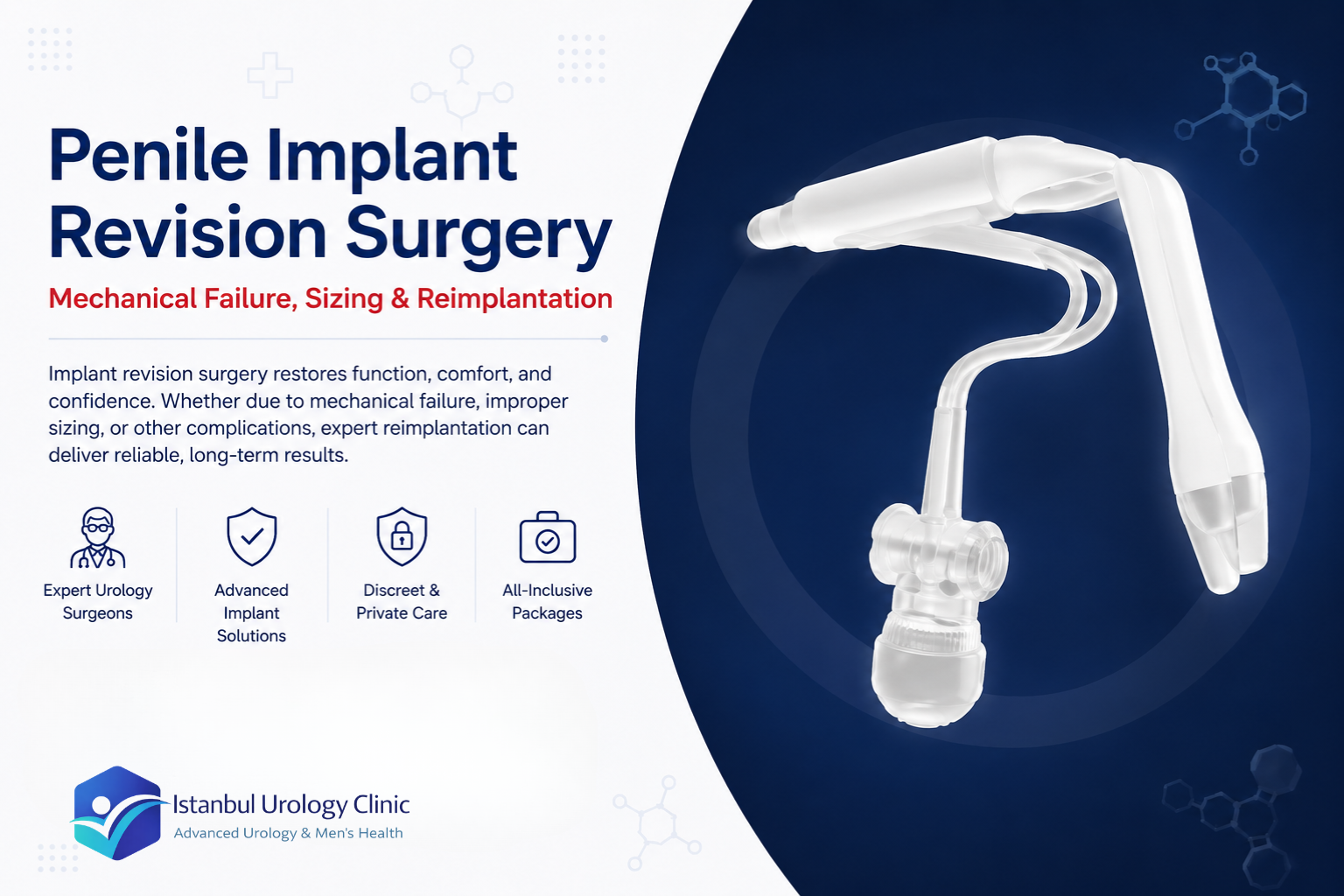
If you are reading this, your situation is not the same as a man considering a penile implant for the first time. Something happened. A device that stopped working, an infection that forced removal, or a result that never matched what you were promised. You are looking for honest information about what happens next, and whether a second procedure can give you the outcome you originally expected.
This article is written for three specific groups. The first has an implant that worked for years and is now failing mechanically. The second is living with a previous implant that was placed badly, with wrong sizing, poor positioning, or function that never worked properly. The third lost their implant to infection, lived without it for months or years, and wants to know if a new implant is still realistic.
Penile implant revision surgery is not one procedure. It is three very different operations, each with its own complexity, its own recovery, and its own honest answer about what can be achieved. The path forward depends entirely on what your previous surgery left behind.
A Realistic Starting Point
Revision is rarely a starting-from-zero procedure, but it is also rarely an exact repeat of your first surgery. Anyone who tells you otherwise without examining you in person is selling, not advising. The outcome depends on what is inside your body right now, not on the brand of the next implant.
Some men arrive at revision evaluation because the implant clearly stopped working. Others arrive because something feels off but they are not sure if it is significant. The patterns below are the signs that consistently bring patients back into our consultation room, and any one of them is reason enough to request an evaluation.
The Pump Stops Inflating Properly
This is the most common reason men return after years of normal function. The squeeze that used to produce a firm erection in a few cycles now requires many more, or it produces only partial inflation, or it produces no response at all. The cause is usually mechanical wear in the pump itself or fluid loss from a small leak somewhere in the system.
The implant did not fail suddenly. It declined gradually, and at some point the decline crossed the threshold of usable function. Recognizing this early matters, because the original post-operative recovery patterns set the baseline for what your implant should still feel like years later.
Auto-Inflation Between Uses
The implant inflates partially on its own, without the pump being activated, often noticeable during the day or after physical activity. This signals that the deflation valve is no longer holding fluid in the reservoir reliably. Beyond the discomfort, auto-inflation is the early warning sign that the hydraulic seal is failing. The implant remains functional, but the trajectory points toward full mechanical failure within months or a year.
Fluid Leak From the System
The penis no longer holds full rigidity. After inflation, firmness decreases within minutes instead of staying stable until deflation is intentional. This means fluid is leaking out of the cylinders, the tubing, or the reservoir back into the body, where the body slowly absorbs it. The reservoir empties, the implant stops working, and revision becomes necessary to replace the leaking component.
New or Worsening Curvature
The penis curves to one side during inflation in a way it did not before, or an existing curve has worsened over time. This points to one of several issues. A cylinder may have eroded slightly into one side of the corporal chamber. The capsule around the implant may have tightened asymmetrically. Or the original sizing favored one side and the imbalance has become more obvious as the surrounding tissue settled. Each cause has a different surgical solution.
Pain During Inflation
Inflation should not hurt. If it has started to, the implant is interacting with the surrounding tissue in a way it should not. Possible causes include cylinder oversizing pressing against the corporal walls, tissue thinning at the tip of the cylinder, infection developing slowly without obvious systemic symptoms, or a component that has shifted out of its original position. Pain during inflation is never something to ignore, and it is never something to push through.
Glans Instability or Tip Droop
The head of the penis no longer holds firm during inflation. The shaft becomes rigid but the glans flops forward or to the side, sometimes called the SST deformity in clinical literature. This usually indicates that the original cylinders are too short, leaving the glans without adequate internal support. Revision in this case is not about replacing a broken implant. It is about correcting a sizing problem that the first surgery did not address.
Visible or Palpable Component Erosion
Part of the implant can be felt through the skin where it should not be, or in rare cases visible thinning of the overlying tissue suggests the implant is pushing outward. This is a surgical emergency category, not a wait-and-see situation. Erosion that breaks through the skin creates direct infection risk, and the implant requires removal before reimplantation can be planned safely.
One sign is enough. You do not need multiple symptoms to justify an evaluation. A single one of the patterns above, present consistently for more than a few weeks, is reason enough to request a revision consultation. Catching mechanical decline early is significantly easier surgically than waiting until the implant has fully failed.
Why Penile Implant Revision Surgery Is Not One Procedure
The label “revision” covers a spectrum wide enough that grouping every case under one name creates more confusion than clarity. A patient whose pump failed after twelve years of normal use is not in the same clinical position as a patient who lost their implant to infection three years ago. The first is essentially a device exchange. The second is reconstructive surgery on tissue that has been through significant change.
In our practice, we separate revision cases into three scenarios from the very first consultation. Each one has different operative complexity, different recovery, different cost, and different honest expectations of outcome. The most important question is not which brand to choose for the second implant. It is which scenario fits your case, because that determines almost everything else. If you are still researching the first procedure rather than a revision, our complete guide to
penile implant surgery covers the primary surgery in full.
Healthy implant that aged out
The tissue planes from the original surgery are preserved. Operative time is shorter, recovery is faster, and complication risk is lower than your first implant procedure.
Previous implant placed incorrectly
The full device must be removed and replaced with corrected measurements. From a surgical and pricing perspective, this is treated as a complete redo of the first procedure.
Implant removed, time spent without one
Scar tissue inside the erectile chambers narrows the space available for new cylinders. This is the most technically demanding revision in prosthetic urology.
Scenario 1. The Implant Wore Out
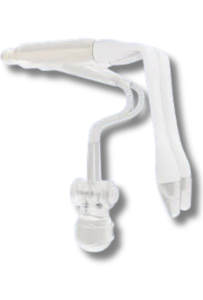 Mechanical failure is the most common reason men eventually return for penile implant revision surgery, and it is also the simplest path forward. Modern three-piece implants typically function reliably for ten to fifteen years, and some last considerably longer. When a component does eventually wear out, the surgery to replace it is straightforward compared to your first procedure.
The reason is anatomical. During the original implant surgery, the surgeon created defined spaces inside the erectile chambers for the cylinders, a pocket in the lower abdomen for the reservoir, and a position in the scrotum for the pump. Those spaces remain prepared. The capsule of healthy tissue that formed around each component over the years gives the next implant a ready-made home.
What actually gets replaced depends on what failed:
- A single cylinder if there is fluid leak or material wear, with the other cylinder left in place
- The pump if it stops responding to standard squeeze pressure or develops a deflation issue
- The tubing between components if a small leak has developed at a connector
- The reservoir if it has shifted, leaked, or lost its valve function
- The entire three-piece system when multiple components have aged together past their reliable working life
Many men leave the hospital faster after a mechanical failure revision than after their first surgery. The swelling is smaller because less tissue is disturbed. Return to walking, office work, and intimacy all happen sooner. When penile implant revision surgery is needed only because of mechanical wear, the news is genuinely better than the patient expected when they first noticed something was wrong with the device.
Scenario 2. The First Surgery Missed
Not every penile implant revision surgery is about a failing device. Some revisions are about a result that never matched what the patient was told to expect. This pattern appears regularly in men who had their original implant placed at clinics where penile prosthesis surgery is occasional rather than routine.
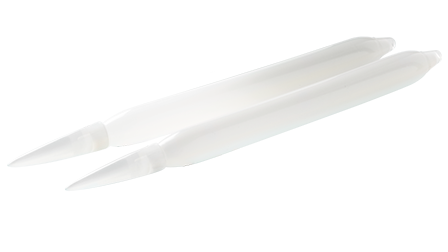
The typical findings in a sizing revision evaluation include cylinders that are too short, leaving an unsupported portion of the penis at the head, cylinders that are too long, producing painful pressure during inflation, a pump positioned awkwardly high in the scrotum, or persistent curvature that the original surgery did not correct. Each of these is fixable, but the fix is not a small adjustment.
Surgical correction in this scenario means removing the existing implant entirely and placing a new one with corrected sizing. Functionally and financially, this is treated as a complete primary surgery, because both a new device and the full operative work are required. The tissue is not as fresh as in scenario one, but it is not as compromised as in scenario three either.
When We Decline These Cases
There are situations where a sizing revision is not the right answer, and it is more honest to say so before booking surgery than after. We decline these cases when the original outcome falls within normal expected ranges and the dissatisfaction is rooted in unrealistic expectations rather than a genuine surgical error.
We also decline when the anatomical limits of the original case were not adequately explained at the time, and those same limits would constrain the second surgery in the same way.
A second procedure cannot deliver dimensions that the patient’s anatomy cannot support, and operating without honest acknowledgment of that limit produces a second dissatisfied patient instead of a corrected one.
Scenario 3. Returning After Removal
The third scenario starts after a difficult chapter. Often it begins with an infection that forced removal of the original implant. Sometimes it follows mechanical erosion through the tissue, sometimes severe pain that did not resolve, occasionally a rare case where the device was removed for non-medical reasons years ago. Whatever brought the patient to explantation, the result is the same. The body lived for a period without an implant in place, and the inside of the penis changed during that time.
The change is corporal fibrosis. Without an implant holding the erectile chambers open, the spongy tissue that used to expand with blood flow gradually hardens into denser, less flexible scar tissue. The chambers narrow. The walls thicken. The natural elasticity that allowed dilation during the original surgery is no longer there. By the time a man returns asking about reimplantation, the inside of the penis no longer resembles what it looked like before the first surgery.
2 to 3 cm
Average penile length lost during the period without an implant after explantation. Earlier reimplantation preserves more length than delayed reimplantation.
Surgery in this scenario is the most demanding form of penile implant revision surgery in routine clinical practice, and many clinics decline these cases for that reason. The operation requires specialized corporal dilation, sometimes the use of dilators in escalating sizes, and occasionally tunical grafting where the chambers are too narrow to accept even a downsized cylinder. Operative time is longer. The risk of intraoperative perforation is higher. The implant choice is often constrained because some cylinder profiles will not fit the available space.
Realistic expectations matter more in this scenario than in any other. Many men can have a successful implant placed, with a functional outcome that restores their sexual life. Some recovery of length is possible with the right cylinder model, particularly when reimplantation happens within the first year after explantation. Full recovery of pre-explantation length is rare in cases where significant time passed without a device. Honest discussion of this gap is part of the consultation before any surgical decision is made.
The Evaluation That Determines What Is Possible
Revision evaluation is not the same conversation as primary evaluation. A man considering his first implant needs to understand what the device does and whether he is a candidate. A man considering penile implant revision surgery needs an honest answer about something far more specific: what is realistically achievable given what his body has already been through.

Our revision evaluation follows a structured sequence that is longer than the primary consultation, not shorter:
- Review of the original surgical records. Operative reports from the previous surgery, the brand and model of the original implant, sizing documentation, and follow-up notes. When records are missing, we work with what the examination reveals.
- Physical examination focused on corporal compliance. The flexibility of the erectile chambers, the position and condition of any remaining implant components, scrotal anatomy, and signs of fibrosis or skin compromise.
- Imaging when indicated. Corporal ultrasound, or in selected cases MRI, when the internal anatomy needs to be mapped before surgery. Most cases do not require imaging. Post-explantation cases often do.
- Honest assessment of expectations against anatomy. What the patient is hoping for, and whether the body can actually deliver it. This is where the surgical decision frequently becomes the decision not to operate, or to recommend a different implant type than the patient initially expected.
- Discussion of timeline, surgical add-ons, and realistic outcomes. Operative time, expected recovery in this specific scenario, additional costs that may apply, and what the next twelve months will look like.
Remote review of records and photographs can begin the evaluation, but no surgical decision is made before in-person examination. Revision booked without examination is not safe practice.
Clinical recommendations from the International Consultation on Sexual Medicine emphasize that revision cases require careful pre-operative assessment of corporal anatomy, prior surgical history, and patient expectations, and that surgical planning in revision differs substantially from primary implantation.
ÖO.
In our practice, the revision consultation is longer than the primary consultation, not shorter. We need to understand what was done before, why it did or did not work, and whether the next surgery can deliver what the patient is hoping for. The decision to operate is sometimes the decision not to operate, and that conversation requires more time than men expect.
Prof. Dr. Ö. Onuk
Professor of Andrology
A Patient Who Was Told There Was No Path Forward
An international patient arrived at our clinic after a difficult history. His original penile implant had been placed in his home country, developed complications, and was removed. A second implant was attempted later at the same center. That one also became infected and was eventually removed. The team there told him there was no path forward, and he should accept living without an implant permanently.
When he came to us for evaluation, the recurring infections did not fit the typical pattern. Repeated implant infection in the same patient usually points to an underlying issue that was missed, not to bad surgical luck twice. The detailed examination, supported by imaging, revealed the actual problem. One of the previous surgeries had caused damage to the urinary channel, and urine was leaking into the surrounding tissue. That leak was the source of the recurring infections. Until it was repaired, no implant of any kind could survive.
The surgical plan was sequential, not immediate. We first repaired the urethral injury and waited four months for full healing. The patient returned for re-evaluation, and the imaging confirmed clean tissue with no further leak. At that point, the implant conversation could start. But the years of fibrosis from two prior explantations had narrowed the corporal chambers significantly, and an inflatable implant, which is what he originally wanted, would not fit safely into the available space.
The honest conversation followed. A malleable implant could be placed now, restore function, and gradually dilate the corporal tissue over time. After about a year, the option to convert to an inflatable could be reconsidered if the tissue had recovered enough flexibility. The patient chose to proceed with the malleable. He did not return for the inflatable conversion. At his follow-up, he said the malleable had given him back what he had stopped expecting was possible, and he no longer felt the need to push for the original plan.
Composite case representative of patients in our practice. Specific identifying details have been changed.
What Recovery Looks Like After Revision Surgery
Recovery after penile implant revision surgery does not follow a single timeline. It follows three timelines, one for each scenario. The differences are significant enough that grouping them together would mislead the patient about what to expect during the first weeks after the operation.
← Swipe to see full table →
| Recovery Milestone | Primary Surgery | Mechanical Failure Revision | Post-Explantation Reimplantation |
|---|
| First 72 hours | Significant swelling, peak day 3 | Less swelling, peak day 2 | Significant swelling, peak day 3 to 4 |
| Walking comfortably | Day 7 | Day 4 to 5 | Day 7 to 10 |
| Office work return | Day 10 to 14 | Day 7 to 10 | Day 14 to 21 |
| Device activation | Week 4 to 6 | Week 4 | Week 6 to 8 |
| Sexual activity cleared | Week 6 | Week 5 to 6 | Week 8 to 10 |
Sizing revision recovery typically tracks the primary surgery timeline, since the operative work is similar in scope. For the complete primary recovery picture, including the first 72 hours, return to activity, and the device activation phase, see our detailed penile implant recovery timeline.
Risks That Differ from Primary Implant Surgery
Honesty about penile implant revision surgery risk matters more than honesty about primary surgery risk, because the men reading this section have already lived through complications once. The risk profile of revision is genuinely different from primary surgery, and pretending otherwise serves no one.
- Higher infection rate. Reported infection rates in revision surgery sit at roughly 2 to 5 percent across published series, compared with below 1 percent in primary implant cases at experienced centers. The risk rises further in post-explantation reimplantation following infection-driven removal.
- Intraoperative complications during corporal dilation. Particularly in post-explantation cases, the fibrosis of the erectile chambers raises the risk of perforation or false passage during dilation. Surgical experience reduces this risk substantially but does not eliminate it.
- Sizing dissatisfaction in scarred tissue. The cylinder must fit the available space. In a tight or scarred corpora, the available space may be smaller than what the patient is hoping for, and the final dimensions may fall short of the original implant.
- Wound healing delays in patients with multiple prior surgeries. Each previous incision affects how the tissue responds to a new one. Diabetic patients on repeat surgery require especially careful glucose management before and after the operation.
- Implant choice constraint. Some cylinder models simply will not fit certain post-explantation anatomies. The brand discussion that mattered before the first surgery sometimes becomes irrelevant in revision, because the anatomy chooses the implant.
Guidelines from the European Association of Urology consistently identify surgeon experience and case volume as the most significant modifiable factors in reducing revision-specific complications. This is one of the few areas in urology where the choice of clinic matters more than the choice of device.
Cost, Warranty, and Realistic Financial Expectations
Pricing for penile implant revision surgery follows the same three-scenario logic as the surgery itself. A mechanical failure revision costs significantly less than a primary implant, with the surgical fee alone running at roughly a quarter of a primary case. Sizing correction is treated like a primary case from a pricing perspective, because both a new device and the complete operative work are required. Post-explantation reimplantation carries an operative complexity surcharge above the standard implant package, reflecting the additional surgical time rather than a markup.
The warranty paradox catches every patient who has not had it explained clearly. Brands such as Rigicon and Coloplast offer lifetime device replacement warranties, which means the implant itself arrives free if it fails mechanically. The hospital fee, the surgical fee, the anesthesia, and the hotel accommodation for any future revision are all billed at the rates applicable at the time of the second surgery. The replacement device is covered. The surgery to place it is not. This applies across every major brand currently in clinical use.
For the complete breakdown of pricing across each revision scenario, including what is included in the package and what is billed separately, see our detailed penile implant cost in Turkey guide.
Why Surgical Volume Matters More in Revision
Volume changes outcomes in every type of surgery, but it changes outcomes more in penile implant revision surgery than in primary cases. The reason is variability. A primary case is predictable. The anatomy is consistent enough that a competent prosthetic urologist can plan most of the procedure before the patient is on the table. A revision case is not predictable in the same way. What the surgeon finds inside depends on what the previous surgery left behind, and the surgical plan often shifts during the operation itself.
This is where experience separates outcomes. A surgeon who performs revision regularly knows when to switch implant model during the procedure, when to call for a downsized cylinder, when to add a graft, when to abandon a difficult dilation and reposition rather than force progress through tissue that is not cooperating. These decisions cannot be learned from textbooks. They come from having operated on enough revision cases to recognize the patterns.
Our team performs revision cases regularly, including the post-explantation cases that many clinics decline. The decision to accept a revision case is made after evaluation, not before. There are cases we do not accept, and we explain why in the consultation rather than discovering the limit during surgery.
When to Travel for Revision Surgery
Many men instinctively want to return to the surgeon who placed the original implant. This is reasonable in some cases and unreasonable in others. Returning to the original surgeon makes sense when the implant failed mechanically after years of normal function, the original team performs revision routinely, and the patient retains confidence in their judgment. The anatomy is documented, the original implant choice was sound, and the revision is essentially a device exchange in familiar territory.
Traveling for a different surgical team makes more sense when the original surgery itself produced the problem, whether through wrong sizing, poor positioning, or a complication that suggests the original team lacks the volume to handle prosthetic urology safely. It also makes sense when the case has become complex enough that the original surgeon’s center does not routinely operate at that level of difficulty, particularly in post-explantation reimplantation. The right surgeon for your second surgery is not always the one who did your first.