

Most men first encounter Peyronie’s disease as a sudden visual change. The penis bends during an erection in a way it never did before. Sometimes a hard area can be felt under the skin. Sometimes the bend is accompanied by pain. Sometimes there is shortening. The natural reaction is to focus on the curve, because the curve is what you can see.
The curve is the symptom. The disease is something else. Peyronie’s is a condition where fibrous scar tissue forms inside the outer covering of the penis, in a layer that is supposed to stay elastic. The scar does not stretch the way healthy tissue does, so during erection the penis bends toward whichever side the scar sits. The visible result is the bend. The actual problem is the scar.
Understanding Peyronie’s disease as a scar tissue condition rather than a curvature condition changes the treatment conversation completely. Scars behave differently at different stages. They form, they evolve, they sometimes calcify, and eventually they stabilize. The treatment that helps a scar in its first months is not the treatment that helps a scar that has fully matured. This is why the same disease in two different men can require very different approaches, and why timing is one of the most important variables in deciding what to do.
This guide walks through what Peyronie’s disease actually is, the two phases the disease moves through and why phases matter so much for treatment, the symptoms beyond the curve itself, what causes the condition, how it is diagnosed, what the treatment options look like at each stage, and what realistic outcomes look like. If you are still uncertain whether your curvature is Peyronie’s specifically or another type, our penile curvature differential guide covers that question first.
- What Peyronie's Disease Actually Is
- The Two Phases That Define Treatment
- Symptoms Beyond the Curve
- What Causes Peyronie's Disease
- How Peyronie's Disease Is Diagnosed
- Treatment by Disease Phase
- When Penile Implant Becomes the Answer
- What Treatment Can and Cannot Achieve
- Living With Peyronie's Disease
- The Path Forward Depends on Where You Are
- What Peyronie's Disease Actually Is
- The Two Phases That Define Treatment
- Symptoms Beyond the Curve
- What Causes Peyronie's Disease
- How Peyronie's Disease Is Diagnosed
- Treatment by Disease Phase
- When Penile Implant Becomes the Answer
- What Treatment Can and Cannot Achieve
- Living With Peyronie's Disease
- The Path Forward Depends on Where You Are
What Peyronie's Disease Actually Is
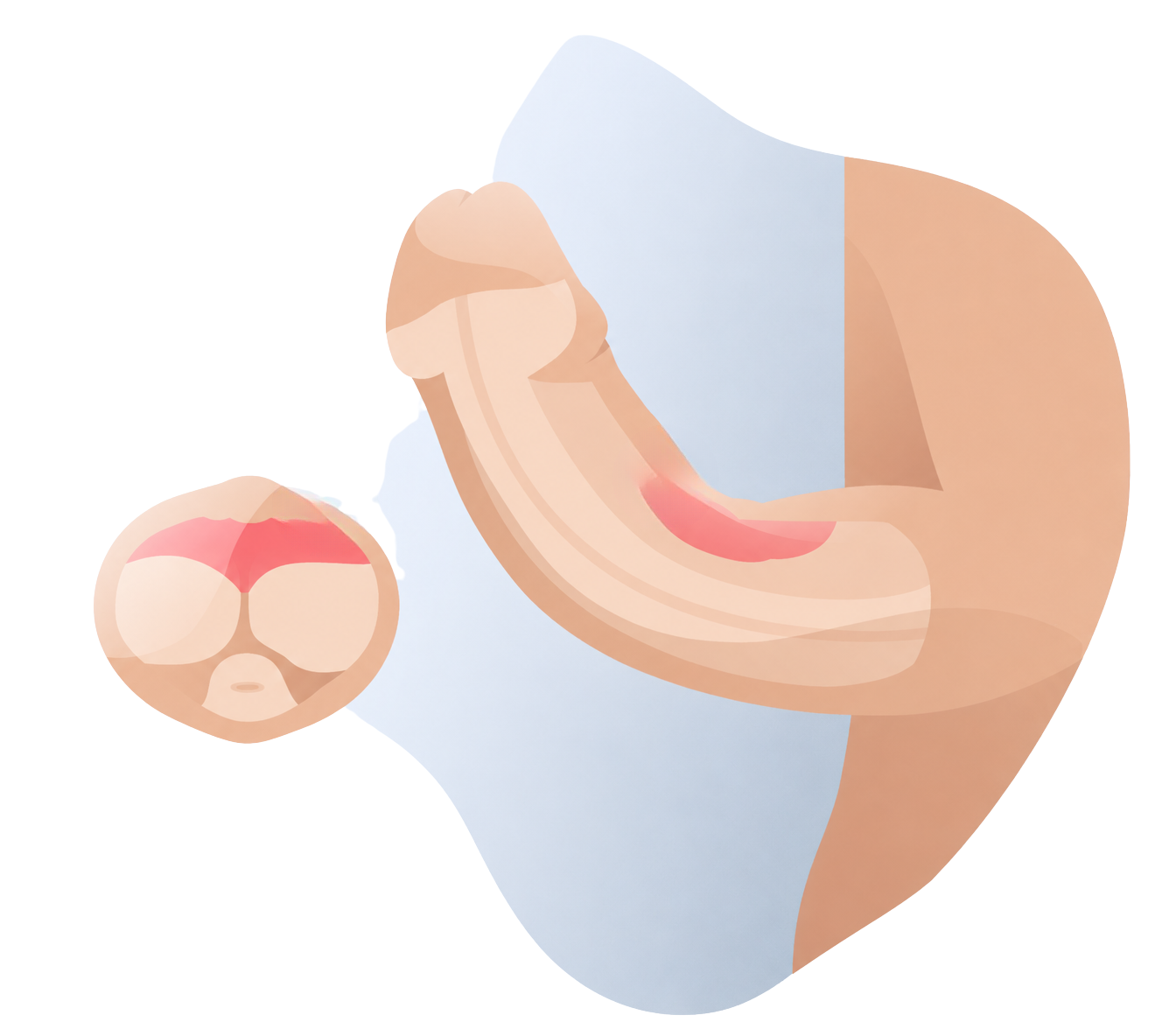 The penis has two parallel chambers running along its length called the corpora cavernosa. These chambers are what fill with blood during an erection. Surrounding the chambers is a tough, elastic outer covering called the tunica albuginea. The tunica is the layer that stretches during erection to accommodate the blood-filled chambers expanding inside it.
In Peyronie’s disease, a patch of fibrous scar tissue, called a plaque, forms inside this outer covering. The plaque can be small or large, single or multiple, soft or eventually calcified. What matters clinically is that the plaque is rigid where the rest of the tunica is elastic. During erection, the surrounding tissue stretches normally, but the area containing the plaque cannot stretch the same way. The result is a bend toward the side of the plaque, because that side of the penis is held back while the rest expands.
This is the mechanical reason behind every visible symptom of Peyronie’s. The bend, the shortening, the hourglass-shaped narrowing some men develop, and even much of the erectile dysfunction that appears in advanced cases all trace back to scar tissue interfering with the normal expansion of erectile tissues during arousal.
Peyronie’s disease is also different from a curve that has been present since adolescence. Congenital curvature involves no scar tissue, no inflammation, and no progression. The shape was simply how the tissues developed during puberty. Peyronie’s is acquired, meaning the penis was straight or close to it before the scar started forming, and the condition is active in a biological sense. It is happening, not just present.
The Two Phases That Define Treatment
Peyronie’s disease does not stay the same over time. It moves through two distinct phases, and the difference between them is the single most important variable in deciding how to treat the condition. The right treatment in the wrong phase often does not work. Worse, in some cases it can make outcomes worse than doing nothing.
The active phase is the early stage of the disease. The scar tissue is still forming. The curvature may still be increasing. Pain during erection is common in this phase, sometimes even before any visible bend appears. The active phase typically lasts 6 to 18 months from when symptoms first appear, although it can be shorter or longer depending on the individual. The plaque is biologically active, meaning it is still being remodeled by the body’s healing response. This matters because the scar can sometimes be influenced during this window in ways that become impossible once it has matured.
The stable phase begins when the disease stops changing. The curvature has settled into its final shape. Pain has resolved. The plaque is no longer forming or growing. In this phase, the scar tissue has matured and often calcified. The condition is no longer progressing, but it is also no longer flexible to treatments that work on active inflammation. What you see is what you have, and the focus shifts from stopping progression to correcting what is now permanent.
Active Phase
Duration: 6 to 18 months typically. Scar tissue still forming. Curvature may still be changing. Pain during erection is common. Treatment focus: stabilize and reduce progression.
Stable Phase
Duration: indefinite, often lifelong without intervention. Curvature has settled. Pain has resolved. Plaque may be calcified. Treatment focus: correct curvature surgically if functionally significant.
Recognizing which phase you are in is something you can usually do with reasonable accuracy on your own. If the bend appeared in the last year and is still changing, or if erections still hurt, you are most likely in the active phase. If the curvature has looked the same for a year or more and there is no pain, you are most likely in the stable phase. A proper evaluation confirms this, but the patient’s own observation of stability over time is usually the strongest clue.
The reason this matters is direct. Surgery during the active phase often produces unpredictable results because the underlying disease is still evolving. Conservative treatments during the stable phase, when the scar has matured, rarely produce meaningful improvement. Matching the treatment to the phase is one of the most important judgments in managing the condition.
Symptoms Beyond the Curve
The bend is what most men notice first, but it is rarely the only symptom of Peyronie’s disease. The full picture varies significantly between patients and depends heavily on which phase the disease is in.
During the active phase, the most common companion symptom is pain during erection. The pain is usually located along the area where the plaque is forming, and it can occur with or without sexual activity. For many men, the pain appears before the curvature becomes obvious, which means an early evaluation often catches the condition before significant deformity develops. Pain during the active phase typically resolves on its own as the disease moves into the stable phase, even without specific treatment.
Penile shortening is another common finding, and one that distresses patients more than the curvature itself in many cases. The scar tissue does not stretch during erection, which means the affected portion of the penis cannot achieve its full length. Over time, this produces measurable loss of length. The amount varies widely from millimeters to several centimeters depending on the size and location of the plaque.
Some men develop an hourglass deformity, where the penis narrows at the location of the plaque while remaining wider above and below it. This indentation can make erections feel unstable, because the narrowed area does not support the weight and pressure of the segments beyond it. Hourglass deformity often signals more advanced fibrosis than simple curvature alone, and the treatment planning is usually more complex.
Erectile dysfunction develops in a significant proportion of Peyronie’s cases, particularly in advanced disease, as documented in the EAU Guidelines on Sexual and Reproductive Health. The same scar tissue that bends the penis can also interfere with the ability of the erectile chambers to fill with blood and trap it during arousal. When erectile dysfunction is part of the picture, treatment planning changes substantially, because correcting the bend alone will not restore reliable sexual function.
| Symptom | Active Phase | Stable Phase |
|---|---|---|
| Pain during erection | Common, sometimes severe | Usually resolved |
| Curvature progression | Bend may still be changing | Stable, no further change |
| Palpable plaque | May be soft or hard | Often calcified, firm |
| Penile shortening | May still be developing | Settled at final length |
| Erectile dysfunction | May appear and worsen | Stable, may need separate treatment |
The Psychological Reality
Peyronie’s disease has a significant psychological dimension that often gets minimized in clinical conversations. Research consistently shows that the emotional impact of the condition is severe for most patients, not occasional.
These figures come from a 2026 retrospective analysis of 603 patients published in Archivio Italiano di Urologia e Andrologia. They reflect what most experienced andrology clinics see daily. Anxiety about progression, fear of permanent change, avoidance of intimacy, and strain on existing relationships are part of the condition for the majority of patients. This is not a side concern to address after the physical problem is solved. The psychological impact is one of the strongest reasons to seek evaluation early rather than waiting for the disease to declare itself further.
What Causes Peyronie's Disease
The honest answer to what causes Peyronie’s disease is that the exact mechanism remains uncertain in most cases. There is no single trigger that explains every patient. What we know is that the condition involves abnormal wound healing inside the penis, where the body’s natural repair process produces excessive scar tissue instead of returning the area to its previous elastic state.
The most widely accepted theory is the micro-trauma hypothesis. Small injuries to the tunica albuginea during sexual activity, often too minor to be noticed at the time, may trigger an inflammatory response that goes too far. In men with a normal healing response, these micro-injuries resolve without any lasting effect. In men with a predisposition toward fibrotic healing, the same injuries can lead to plaque formation. This is why two men can have similar sexual histories and only one develops Peyronie’s.
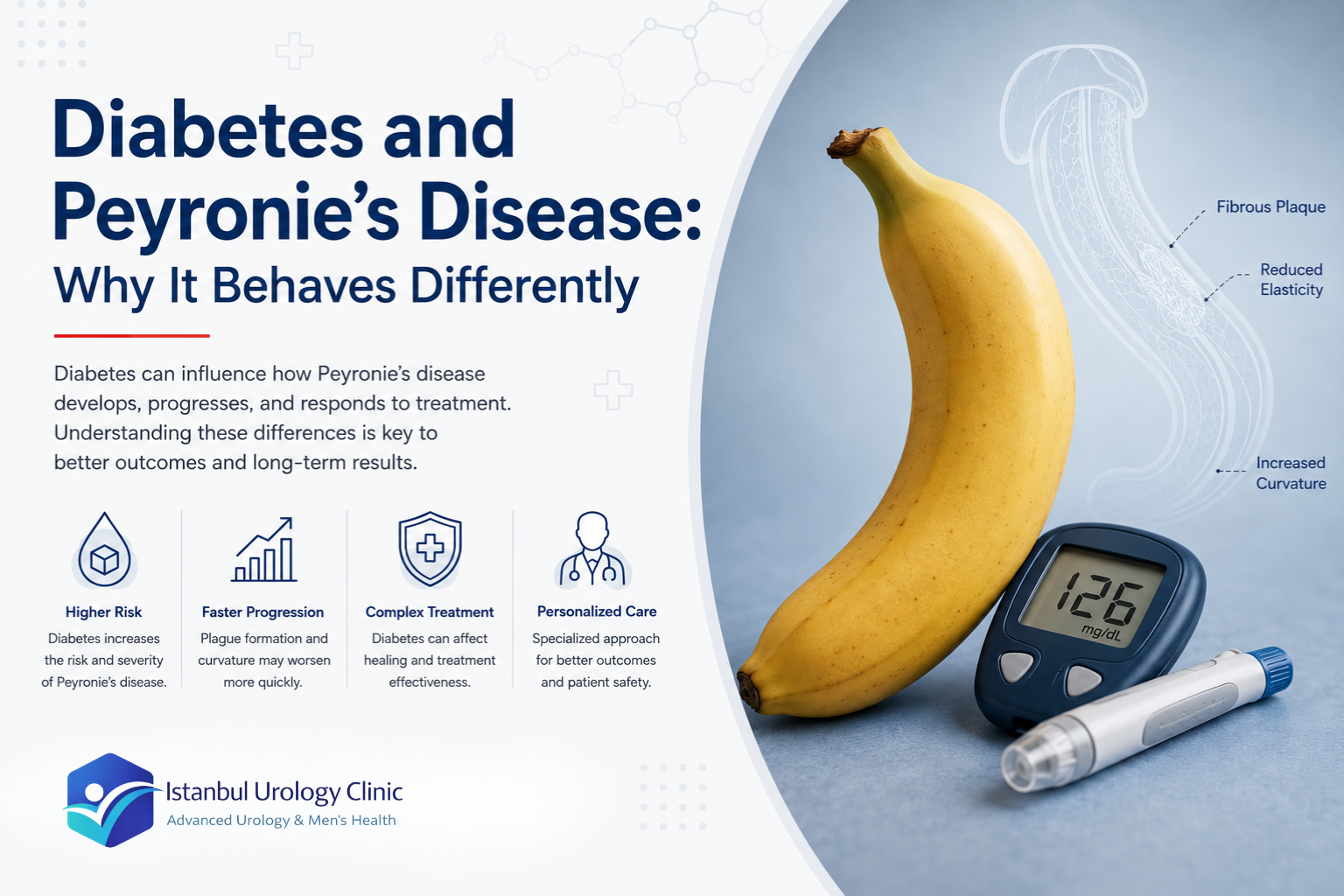
Several factors raise the risk of developing the condition. Age is the strongest single factor, with most cases appearing between 40 and 70 as tissue elasticity decreases naturally. Diabetes is another well-established risk factor, both because of its effect on blood flow and because of how it alters tissue healing patterns more broadly. Our article on how diabetes raises Peyronie’s risk covers this connection in detail.
Genetic predisposition plays a role, although the exact genes involved are still being studied. A notable proportion of men with Peyronie’s disease also have Dupuytren’s contracture, a similar fibrotic condition affecting the hands. The association between the two is one of the strongest pieces of evidence that some patients have a generalized tendency toward excessive scar formation, as reflected in current EAU clinical guidance. Other connective tissue conditions, including Ledderhose disease affecting the feet, also occur more frequently in men with Peyronie’s than in the general population.
Other contributing factors include previous pelvic surgery, particularly radical prostatectomy, smoking, and certain medications that affect tissue healing. None of these are sufficient on their own to cause Peyronie’s disease. They raise the risk in combination with the underlying biological vulnerability that some men carry and others do not.
For most patients, identifying a single cause is not possible and not necessary. The disease is here. What matters next is what phase it is in and what treatment direction makes sense.
How Peyronie's Disease Is Diagnosed
Diagnosing Peyronie’s disease is usually straightforward. A focused medical history asking when symptoms started, whether they are progressing, and what the patient has noticed, combined with a physical examination of the penis, is enough to establish the diagnosis in most cases. The examination looks for palpable plaques, assesses the location and direction of any deformity, and checks for shortening or hourglass narrowing.
Patients are asked to provide photographs taken at home during erection, ideally from multiple angles. These pictures show the true degree and direction of the curve more accurately than any office assessment can, since most men cannot achieve a full erection in a clinical setting. The photographs also serve as a baseline for monitoring whether the condition is progressing.
When erectile function is in question, or when the underlying tissue condition needs further assessment, a penile Doppler ultrasound is added to the workup. The Doppler evaluates blood flow inside the penis, assesses the size and characteristics of the plaque including whether it has calcified, and identifies any underlying vascular contribution to erectile dysfunction. Doppler findings often change the treatment plan, particularly when the patient is considering surgery, because the imaging can reveal that erectile dysfunction is a larger factor than the patient realized.
Beyond examination and imaging, diagnosis is rarely complicated. Blood tests, biopsies, and advanced imaging like MRI are not routinely needed and add little for most patients.
Treatment by Disease Phase
The single most useful framework for Peyronie’s disease treatment is to match the treatment to the phase. The same patient at month 6 of the disease needs a different approach than they will at month 24 once the condition has stabilized.
Active Phase Treatment
During the active phase, the goal is to stabilize the disease, reduce inflammation, manage pain, and limit further progression. Surgery during this phase is generally avoided because the underlying condition is still evolving and results are unpredictable.
Oral medications including pentoxifylline and vitamin E are sometimes used to support tissue health, although their effectiveness on curvature itself is modest. Intralesional injections, where medication is delivered directly into the plaque, are the most evidence-supported active-phase treatment. Collagenase injections were widely used until the medication was withdrawn from the European market in 2020, and alternatives including verapamil injections continue to be used in selected cases. Low-intensity shockwave therapy can help with pain reduction and may modestly improve tissue quality, although it is not a definitive treatment for curvature.
The realistic goal during the active phase is not complete reversal. It is to limit how much worse the curvature gets before the condition stabilizes, and to position the patient for the best possible outcome when the disease moves into the stable phase.
Stable Phase Treatment
Once the disease has stabilized, the conversation changes. The curvature is now permanent without intervention, the plaque has matured, and the question is whether the functional impact justifies surgical correction. For mild stable curvature that allows comfortable intercourse, observation remains a valid choice. For curvature significant enough to interfere with sexual function, the surgical options divide into three main approaches.
Penile plication is the most common procedure for mild to moderate curvature with preserved erectile function. The technique balances the two sides of the penis by shortening the longer side. Recovery is relatively fast and the risk of new erectile dysfunction is low. Grafting surgery is used for more severe curvature or cases where preserving penile length is a higher priority. The fibrotic area is released and a graft restores a more balanced shape. The procedure is technically more demanding and carries a higher risk of new erectile dysfunction compared with plication.
Penile implant surgery becomes the right answer when significant erectile dysfunction is present alongside the curvature, since correcting the bend alone will not restore reliable sexual function. This combined situation is covered in the next section.
| Disease Phase | Treatment Focus | Main Options | Surgery Considered? |
|---|---|---|---|
| Active Phase | Stabilize and reduce progression | Oral medications, intralesional injections, shockwave therapy | No, generally avoided |
| Stable Phase (mild) | Observation if function preserved | Monitoring, no intervention needed | Only if patient prefers |
| Stable Phase (significant) | Correct curvature surgically | Plication or grafting depending on severity | Yes, primary treatment |
| Stable + ED | Address both problems | Penile implant with simultaneous curvature correction | Yes, combined procedure |
When Penile Implant Becomes the Answer
In a meaningful subset of Peyronie’s disease cases, the curvature is not the whole problem. Erectile dysfunction is also present, often caused by the same scar tissue that produces the bend. When both issues coexist, treating one without the other usually leaves the patient with a partial result that does not restore sexual function.
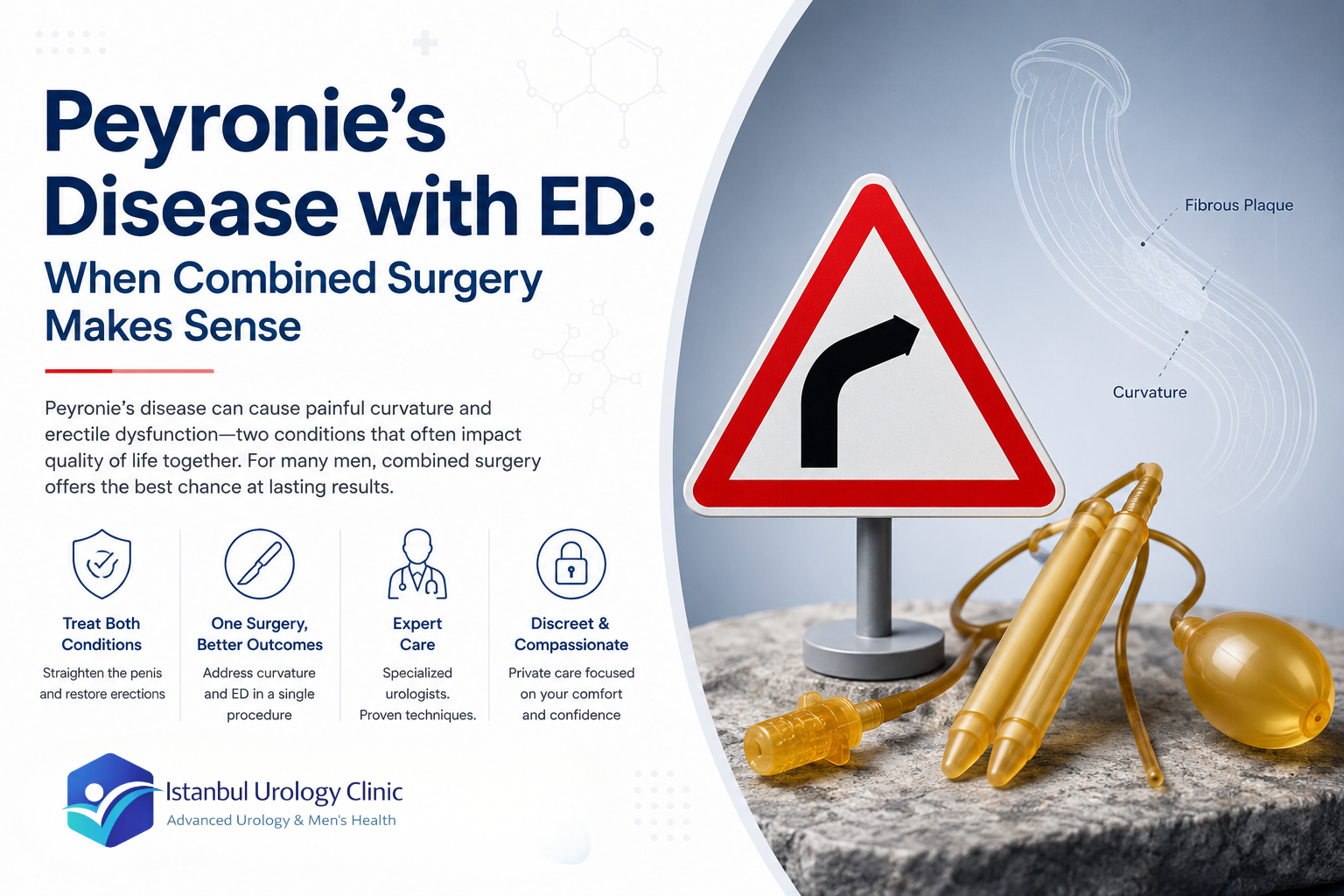
This is the scenario where penile implant surgery moves from being one option among many to being the most reliable solution. The procedure addresses both problems simultaneously: the implant restores erectile rigidity, and the curvature is corrected during the same operation through modeling or grafting techniques performed alongside the device placement. The patient recovers from one surgery rather than two, and the functional outcome is typically more predictable than what reconstruction alone could achieve in the presence of significant erectile dysfunction.
The clinical logic for when this combined approach makes sense, the specific decisions around device selection in Peyronie’s cases, and what realistic outcomes look like for combined surgery are covered in detail in our article on Peyronie’s disease combined with erectile dysfunction. For the surgical details of inflatable implants more broadly, our penile implant surgery guide covers the full procedure.
For patients with Peyronie’s disease and preserved erectile function, penile implant surgery is not the first option and usually not needed at all. Plication or grafting handles the curvature without the complexity of a device. The implant becomes relevant specifically when erectile function has already been lost or is in the process of being lost.
What Treatment Can and Cannot Achieve
One of the most important conversations our team has with patients before any treatment decision is about realistic outcomes. The wrong expectations going in often produce dissatisfaction even after technically successful treatment. The right expectations produce satisfaction even with imperfect results.
The honest framing is that Peyronie’s disease treatment is about restoring function, not restoring the exact penis the patient had before the disease started. A treatment that makes intercourse comfortable, eliminates pain, prevents further progression, and produces a functionally straight erection is a successful outcome, even if a small residual curvature remains or the penis is slightly shorter than it was before.
For active-phase treatment, the realistic goal is stabilization, not reversal. Most conservative treatments slow progression and may produce modest curvature reduction. They rarely eliminate the bend entirely. Patients who expect complete resolution from injections or shockwave therapy are usually disappointed. Patients who understand that the goal is limiting further damage during the active window are generally satisfied with the outcome.
For surgical treatment in the stable phase, the outcomes are more predictable. Plication and grafting consistently produce functional improvement in well-selected patients. The trade-offs are known in advance: a small amount of shortening with plication, a longer recovery with grafting, a small risk of new erectile dysfunction with either procedure. None of these are deal-breakers when the alternative is continued sexual dysfunction.
For combined implant surgery in Peyronie’s plus erectile dysfunction, published outcomes data show consistently high patient satisfaction when device selection and surgical technique are matched to the case. The reason is that the implant solves the erectile dysfunction definitively, and the simultaneous curvature correction addresses the deformity, leaving the patient with reliable function on demand.
Living With Peyronie's Disease
For most patients, having Peyronie’s disease is not only about the curvature itself. It is also about uncertainty, anxiety, and the impact on relationships. These are part of the condition and deserve direct attention rather than being minimized.
The anxiety in the active phase is often the worst part of the experience. The patient watches the curvature change, fears it will get much worse, and feels unable to do anything about it. Knowing what is happening biologically, understanding that the active phase is finite, and having a treatment plan even if it is conservative all reduce this anxiety significantly.
The relationship dimension matters too. Many men withdraw from intimacy when Peyronie’s appears, both because of physical discomfort and because of self-consciousness about the change in penile appearance. Partners often interpret this withdrawal as something else, which can produce strain that compounds the original problem. Direct conversation with a partner about what is happening medically is one of the most useful steps a patient can take.
Knowing when to seek evaluation rather than wait is the other key part. Any new curvature deserves an evaluation in the weeks after it appears rather than the months. Any progressive pain during erection deserves prompt attention. Any combination of curvature with erectile dysfunction needs evaluation soon, because the combined treatment options are broader earlier in the disease than later.
Frequently Asked Questions
The active phase shows recent onset of curvature, pain during erection, or changes in the bend over the past 6 to 12 months. The stable phase means the curvature has looked the same for at least 6 to 12 months and pain has resolved. A urological evaluation confirms this, but your own observation of stability over time is usually the strongest clue.
The Path Forward Depends on Where You Are
Peyronie’s disease is manageable, but it is not a condition that resolves itself or improves with time alone. The active phase decides how much curvature you will eventually have. The stable phase decides what your treatment options look like once the disease has settled. Where you stand on that timeline matters more than the degree of the bend itself.
For most men, the right next step is an evaluation that establishes which phase you are in, whether erectile function is being affected, and what realistic outcomes look like for your specific case. From there the decisions become straightforward. Conservative treatment during the active phase. Surgical correction in the stable phase when curvature is functionally significant. Combined implant surgery when erectile dysfunction is part of the picture. None of these are guesses. Each one has a clear clinical indication, and matching the treatment to the situation is what produces results that last.
The patients who do best with Peyronie’s disease are not the ones who acted fastest or the ones who waited the longest. They are the ones who understood what they were dealing with, evaluated their options honestly, and chose the approach that fit their specific phase, anatomy, and goals. That decision starts with knowing what is happening, and that is what evaluation provides.