

If you are reading this, you have probably already measured yourself, compared yourself to figures online, and reached the conclusion that something is wrong. Most men who come to our clinic concerned about micropenis arrive with the same fear and the same internal conversation. Very few of them leave with the diagnosis they expected.
True micropenis is a specific medical condition with strict measurement criteria. It is uncommon. What is far more common is a normal penis that looks smaller than it is, a buried shaft hidden beneath excess pubic fat, or healthy anatomy distorted by years of comparison with content that is not based on reality.
Before any treatment is discussed, the right first step is always the same: confirm the diagnosis. A measurement done correctly, in a clinical setting, by someone who has examined thousands of patients, tells you in a few minutes whether you are dealing with a true medical condition or a perception problem. The treatment depends entirely on that answer, and so does whether you need treatment at all.
This guide walks you through exactly how micropenis is properly evaluated, diagnosed, and treated. It is the same diagnostic pathway Prof. Dr. Onuk uses with every patient who walks into consultation worried about size, and it explains why the full range of penile enlargement options only enters the conversation after the diagnosis itself is confirmed.
Quick Answer
- What Micropenis Actually Is (And What It Isn't)
- How We Measure: The Stretched Penile Length (SPL) Method
- Our Diagnostic Pathway:
- When the Penis Looks Smaller Than It Is
- What Actually Causes True Micropenis
- Treatment Depends on Your Age
- A Real Case from Our Clinic
- The Honest Conversation About Adult Treatment
- Why Diagnosis Comes Before Surgery
- Start With the Right Answer, Not the Wrong Procedure
- What Micropenis Actually Is (And What It Isn't)
- How We Measure: The Stretched Penile Length (SPL) Method
- Our Diagnostic Pathway:
- When the Penis Looks Smaller Than It Is
- What Actually Causes True Micropenis
- Treatment Depends on Your Age
- A Real Case from Our Clinic
- The Honest Conversation About Adult Treatment
- Why Diagnosis Comes Before Surgery
- Start With the Right Answer, Not the Wrong Procedure
What Micropenis Actually Is (And What It Isn't)
Patients use the word micropenis loosely. In clinical practice, the word has a specific meaning, and the difference matters because it changes everything that follows.
True micropenis is a medical condition. It is diagnosed using a standardized measurement called stretched penile length, and the result has to fall below a specific threshold for the diagnosis to apply. The condition itself is uncommon in the general population, and even more uncommon among the men who suspect they have it.
A naturally small penis is something different. The measurement is below average but still within the medically normal range. There is no condition to treat. The anatomy is functioning as it should, and any procedure performed on it would be cosmetic by choice, not medical by necessity.
Size anxiety is a third category, and the most common one we see in consultation. The measurement is normal or even above average, but the perception is shaped by years of comparison with unrealistic material online, partner remarks, locker room memories, or persistent self-doubt. The anatomy is fine. The concern is real, but the cause is not anatomical.
This is the first triage we perform with every patient. Without it, the treatment plan is built on the wrong foundation.
| Category | What the Measurement Shows | What It Means for Treatment |
|---|---|---|
| True Micropenis | Stretched penile length below approximately 7 to 8 cm in adults, often linked to hormonal or developmental factors | Specialized evaluation, possible hormonal therapy in younger patients, limited surgical options in adults |
| Naturally Small Penis | Below average but still within the normal medical range | No medical treatment required. Optional cosmetic procedures available if you choose them |
| Size Anxiety | Measurement is normal or above average | Accurate measurement, honest conversation, and reassurance. No surgery needed |
How We Measure: The Stretched Penile Length (SPL) Method
The single most important number in a micropenis evaluation is not what you measure at home. It is stretched penile length, taken in clinic, with a technique that removes the variables that distort every measurement you have ever done on yourself.
Stretched penile length is exactly what it sounds like. The penis is gently stretched along its full axis, and the distance is measured from the pubic bone to the tip of the glans. This number is far more reliable than flaccid length, because flaccid measurement changes minute by minute. Temperature, anxiety, recent activity, weight, fat distribution, and natural muscle retraction can shift a flaccid measurement by several centimetres on the same person, on the same day.
Stretched length removes almost all of that noise. It approximates erect length closely in the vast majority of men, and it is the measurement every serious urology study uses when discussing penile size. When you read about micropenis criteria, the numbers you see refer to this measurement, not to flaccid length and not to erect length measured by the patient.
Adult Diagnostic Thresholds
In adults, micropenis is generally diagnosed when stretched penile length falls below approximately 7 to 8 cm, which is roughly 2.8 to 3.1 inches. Exact reference values vary slightly between published studies and populations, but this range is the clinically accepted threshold for the diagnosis.
The table below shows the standard adult reference points. Numbers are given in both centimetres and inches because international patients ask for both.
| Stretched Penile Length (SPL) | Centimetres | Inches | Clinical Interpretation |
|---|---|---|---|
| Diagnostic threshold for adult micropenis | ≤ 7 to 8 cm | ≤ 2.8 to 3.1 in | Meets the criteria for further medical evaluation |
| Below average, still within normal range | 8 to 12 cm | 3.1 to 4.7 in | Not micropenis. No medical treatment needed |
| Average adult range | 12 to 14 cm | 4.7 to 5.5 in | Normal anatomy. Concerns are perception based |
| Above average | ≥ 14 cm | ≥ 5.5 in | Normal anatomy. Concerns are perception based |
Why Children and Adolescents Are Measured Differently
In infants, children, and adolescents, a single fixed number does not work. Penile size during development follows age-specific growth curves, and the diagnosis is made by comparing the measurement against established reference values for the patient’s exact age and pubertal stage.
This matters because the window for hormonal treatment is narrow. Identifying a true micropenis case during childhood or early adolescence allows the body to respond to therapy in a way that is no longer possible once growth is complete. For this reason, paediatric measurement is handled with a different protocol from adult evaluation, and the numbers above do not apply to anyone under full skeletal maturity.
Micropenis cannot be diagnosed from a photograph, an online calculator, a Reddit thread, or a comparison with content you have watched. The measurement has to be taken correctly, with the right technique, by someone who knows what they are doing. Most men who measure themselves at home pull harder, position incorrectly, or include the pubic fat pad, and the result is misleading in both directions. If size is genuinely worrying you, the only meaningful first step is a proper clinical measurement.
Our Diagnostic Pathway:
The first consultation at Istanbul Urology Clinic is not a sales conversation. It is a triage. Prof. Dr. Onuk and the team work through a structured pathway designed to answer one question before any other: what is actually going on with this patient’s anatomy?
That answer determines everything that follows. A man who arrives expecting micropenis surgery may leave with reassurance and no procedure at all. Another may leave with a referral for endocrine testing. A third may leave with a clear plan for buried penis correction. The pathway sorts each patient into the right track, and the table below maps how it works in practice.
No medical condition is present. The conversation shifts to understanding why the perception developed and whether elective cosmetic options are something you actually want. Most patients in this group need no treatment at all.
The penis itself is normal length, but appearance is reduced by buried penis, webbed penis, or excess pubic fat. Treatment focuses on correcting the concealing anatomy, not on enlargement.
True micropenis diagnosis is considered. Next step is hormonal evaluation and identification of the underlying cause. Treatment options depend on age, hormone profile, and individual anatomy.
What the Evaluation Includes
Once the SPL measurement places you in one of these three tracks, the rest of the consultation is built around that result.
For patients in the normal range, the evaluation focuses on what is driving the perception. A short conversation with the surgeon, combined with the actual measurement on paper, resolves the concern in most cases. Some patients still want to explore elective enlargement, and that conversation continues separately, with full bridges into the penis enlargement options available at our clinic.
For patients with concealed anatomy, the examination concentrates on identifying the specific cause. Is it pubic fat? Is the scrotal skin attached too high on the shaft? Is there scarring from a previous procedure? Each of these has a different surgical correction, and the plan depends on the finding.
For patients who meet the diagnostic threshold for true micropenis, the evaluation expands into hormonal testing, sometimes genetic testing, and a complete review of medical history. This group is small, but the assessment is the most detailed because the treatment plan has to account for the underlying cause, not just the measurement.
When the Penis Looks Smaller Than It Is
A large portion of patients who come to us convinced they have micropenis turn out to have something else entirely. Their stretched penile length is normal. The problem is that very little of that length is visible from the outside.
This is a different clinical category. The anatomy is healthy, but the appearance is reduced by tissue concealing the shaft. The treatment is targeted at the concealing tissue, not at the penis itself. The conditions below are the three we encounter most often during consultation.
Buried Penis
The shaft is partially or completely hidden beneath surrounding tissue, most commonly because of excess pubic fat, loose abdominal skin after weight loss, or scarring from a previous procedure. The actual penile length is usually normal. Once the concealing tissue is addressed, the shaft becomes visible at its real length, and the change is often dramatic in the first few weeks after correction.
Webbed Penis (Scrotal Webbing)
The skin of the scrotum extends too high along the underside of the penile shaft, anchoring the penis downward and reducing the visible length. The penis is normal. The skin attachment is not. A short corrective procedure releases the skin and restores normal visible length, often in a single surgical session with minimal recovery.
Trapped Penis
This usually develops after circumcision, trauma, or scarring from a previous procedure. The penis is partially trapped behind surrounding tissue, making it appear far shorter than it actually is. Correction depends on the underlying cause and may involve releasing scar tissue or reconstructing the skin around the shaft.
The differential below summarises how the three concealed conditions compare in terms of presentation, underlying cause, and treatment direction. Full surgical detail for each is covered in our guide to penile enlargement surgery.
| Condition | What the Patient Sees | Underlying Cause | Treatment Direction |
|---|---|---|---|
| Buried Penis | Very short visible shaft, often with a fat pad concealing the base | Excess pubic fat, loose skin, post-surgical scarring | Suprapubic correction, often combined with V-Y advancement |
| Webbed Penis | Penis appears short because scrotal skin extends high along the shaft | Skin attachment anomaly between scrotum and penile shaft | Penoscrotal plasty (turkey neck correction) |
| Trapped Penis | Shaft pulled inward or partially fixed by surrounding tissue | Post-circumcision scarring, trauma, previous surgery | Scar release and skin reconstruction |
What Actually Causes True Micropenis
When the diagnosis is confirmed, the next question is always the same. Why did this happen? The answer guides treatment, sets realistic expectations, and explains why outcomes differ so much from one patient to another.
What our consultation experience consistently shows is that the cause is often easier to identify than the timing. Most adult patients who reach our clinic with confirmed micropenis are diagnosed years, sometimes decades, after the developmental window has already closed. The biology that produced the diagnosis happened before birth or in early childhood. The conversation we are having with them is taking place in their thirties or forties. This timing gap is the single most important factor shaping what treatment can realistically achieve.
Hormonal Causes
Hormonal disruption is the most common identifiable cause, and the one with the clearest mechanism. Testosterone exposure during specific windows of fetal and early childhood development drives penile growth. When that exposure is reduced, growth is reduced with it.
In the cases we evaluate, the most frequent finding is hypogonadotropic hypogonadism, meaning the brain does not send the correct signals to the testes to produce testosterone. Pituitary disorders and primary testicular dysfunction account for most of the rest. What our hormonal panels often reveal is not a dramatic deficiency, but a quiet one that went unnoticed for years because nobody thought to look. By the time these patients reach us, the hormonal picture can sometimes be optimised for general health, but the penile tissue itself has long passed the phase where it responds to testosterone with growth.
Genetic Causes
Some chromosomal conditions and inherited syndromes affect either hormone production or the way the body responds to hormones. In these cases, the testosterone may be present but the tissues do not register it correctly. We see this most often in patients who arrive with other developmental signs that were never connected to the size concern, sometimes for their entire adult life.
Genetic testing is not routine for every micropenis patient at our clinic. We recommend it when other developmental features point toward a syndromic cause, when there is relevant family history, or when the hormonal panel does not explain what the examination shows. The test result rarely changes adult treatment options directly. What it changes is the explanation, and many patients find that the explanation itself matters more than they expected.
Developmental and Idiopathic Causes
Disorders of sexual development can affect penile growth as one feature among several. Exposure to certain medications or hormonal disruptions during pregnancy has also been linked to abnormal genital development in some cases.
What surprises most patients is how often the workup ends with no identifiable cause at all. In a meaningful share of the adult micropenis cases we evaluate, complete hormonal and genetic testing returns clean. The measurement still meets criteria. The mechanism remains unknown. We call this idiopathic micropenis, which simply means the diagnosis is real but the explanation is not.
This is one of the harder conversations to have in consultation. Patients arrive expecting that finding the cause will unlock the treatment, and sometimes the workup does not deliver that answer. The plan in those cases is built around what is possible at their current age, not around correcting a cause we cannot identify.
Why the Timing Matters More Than the Cause
Across the hundreds of adult micropenis evaluations performed at our clinic over the years, one pattern is more consistent than any single cause. The biological window during which the penile tissue responds to testosterone closes after puberty. After that point, it does not matter whether the underlying cause is hormonal, genetic, or idiopathic. The tissue stops responding the way it would have responded in childhood.
This is the clinical reality behind every adult micropenis conversation we have. The cause explains the diagnosis. The timing explains the treatment. And the gap between when the biology happened and when the patient reached us is the reason adult treatment is structured around what surgery can rearrange, not around what hormones can still build.
Common Myths About Micropenis
Myth: Pills, supplements, or topical creams can treat micropenis.
Reality: No oral supplement, herbal product, or cream has any effect on penile size in an adult diagnosed with true micropenis. The growth window for tissue response to testosterone closes after puberty. Adult treatment, when offered, is surgical. Anything sold as a non-surgical micropenis cure online is, at best, a waste of money. Full breakdown in our guide on penis enlargement pills.
Myth: Micropenis means you cannot have a normal sex life or children.
Reality: Most patients with micropenis maintain normal erectile function. Fertility depends on the underlying hormonal or genetic condition, not on penile size itself. Many patients with true micropenis father children naturally. The clinical picture varies, but the diagnosis does not automatically mean infertility or sexual dysfunction.
Myth: If your penis is short, it must be micropenis.
Reality: Most short-appearing penises are not micropenis. The diagnosis requires a specific stretched penile length measurement below the clinical threshold. Anything above that range, no matter how it looks, is not a medical condition.
Treatment Depends on Your Age
The single biggest factor that determines what is possible in micropenis treatment is age. The tissue responds differently at different stages of life, and the treatment options narrow significantly once growth is complete. This is why two patients with the same diagnosis can follow completely different treatment paths.
Infants, Children, and Adolescents
The most effective time to treat true micropenis is during childhood and early adolescence, before puberty closes the developmental window. In this group, testosterone therapy under endocrinology supervision can stimulate measurable penile growth when the underlying cause is hormonal. The earlier the diagnosis, the better the response, and short courses of treatment during specific developmental windows can produce meaningful changes that are no longer possible later.
Treatment in this age group is not a single protocol. It is built around the specific hormonal profile, the underlying diagnosis, and the response to initial therapy. Long-term monitoring is part of the plan, because growth, puberty progression, and treatment response all need to be assessed over time. Surgery is rarely considered during this period. The priority is hormonal optimisation while the tissue is still responsive.
Adults
By the time skeletal maturity is complete, the penis has reached its adult size. Testosterone therapy in an adult with true micropenis does not produce further growth, because the tissue is no longer in a developmental phase. This is the hardest conversation to have in consultation, and it is the most honest one. Adult micropenis treatment shifts from growth-based therapy to function-based and appearance-based options.
The options that remain in adulthood are limited in what they can achieve. Penile lengthening surgery, in carefully selected cases, can improve the visible portion of the shaft by releasing the suspensory ligament that anchors the penis to the pubic bone. Girth enhancement procedures can change proportion. None of these procedures create new penile tissue, and none of them deliver the kind of transformation that pills, advertisements, or unregulated clinics imply. The honest conversation about what is realistically possible is the next section of this guide.
| Age Group | Primary Treatment Focus | Realistic Goal | Role of Surgery |
|---|---|---|---|
| Infants and Young Children | Hormonal evaluation, short courses of testosterone therapy under endocrinology supervision | Stimulate growth during the developmental window | Rarely considered at this stage |
| Adolescents | Pubertal assessment, hormonal optimisation, monitoring of growth response | Maximise developmental potential before growth completes | Considered only in selected post-pubertal cases |
| Adults | Functional and appearance-based interventions, realistic expectation setting | Measured improvement in visible length, girth, or proportion | Main treatment route in selected candidates |
A Real Case from Our Clinic
One of the most common patterns we see at Istanbul Urology Clinic is a patient who arrives convinced of a diagnosis that does not match what the examination shows. The case below is one of many examples, anonymised, and shared because it illustrates how often the answer is not the one the patient came expecting.
Background: A man in his early thirties contacted our international patient team after years of believing he had micropenis. He had spent considerable time comparing himself to figures online, had ruled himself out of relationships, and was already researching enlargement surgery before any clinical evaluation had taken place. He arrived in Istanbul prepared to schedule a procedure within the same week.
Evaluation: Prof. Dr. Onuk performed a complete examination, including a properly taken stretched penile length measurement. The result placed him below average but clearly within the normal medical range. The visible portion of the shaft, however, was significantly shorter than the actual measurement, because excess pubic fat and a partially buried appearance were concealing two to three centimetres of healthy anatomy.
Diagnosis: Not micropenis. The condition was a buried penis presentation, driven by pubic fat distribution rather than by any developmental or hormonal cause. His underlying anatomy was normal.
Treatment Plan: Targeted suprapubic correction to address the concealing tissue. No enlargement procedure was offered, because none was clinically appropriate. The conversation in consultation focused on what the measurement actually showed and what realistic improvement would look like once the buried appearance was corrected.
Outcome: The visible length improved noticeably within the first weeks after correction, without any enlargement surgery. The patient left the process with a clearer understanding of his own anatomy, and without undergoing the more aggressive treatment he had initially expected to pay for.
Cases like this are the reason the first step at our clinic is always evaluation, not procedure scheduling. A patient who arrives convinced he needs micropenis treatment in Turkey may leave with a completely different plan, a smaller and more targeted intervention, or sometimes no procedure at all. The clinical answer is whatever the examination shows, not what the patient came expecting.
The Honest Conversation About Adult Treatment
This is the section most adult patients with true micropenis want to skip to. It is also the section where we have to be the most direct, because the gap between what marketing promises and what surgery actually delivers is wider here than anywhere else in urology.
If you are an adult diagnosed with true micropenis, the conversation in our consultation room is honest in three ways. First, no procedure available today creates new penile tissue. Surgery rearranges what is already there. Second, the changes that are possible are measured in modest centimetres, not in transformative numbers. Third, the most successful patients are the ones who arrive with realistic expectations and a clear understanding of what each option can and cannot do.
What Adult Surgery Can Actually Do
For selected adult patients, three categories of change are surgically possible. Each one solves a different problem, and most adult micropenis plans combine more than one of them rather than relying on a single procedure.
Visible length improvement. This comes from releasing the suspensory ligament that anchors the penis to the pubic bone. The internal portion of the shaft, which normally sits hidden inside the body, becomes externally visible. The most noticeable change happens in the flaccid state, where the gain is usually measurable in centimetres. The change in fully erect length is smaller and more variable from one patient to another. For micropenis patients specifically, this procedure is rarely performed alone, because length release without girth adjustment can leave the result looking thinner in proportion.
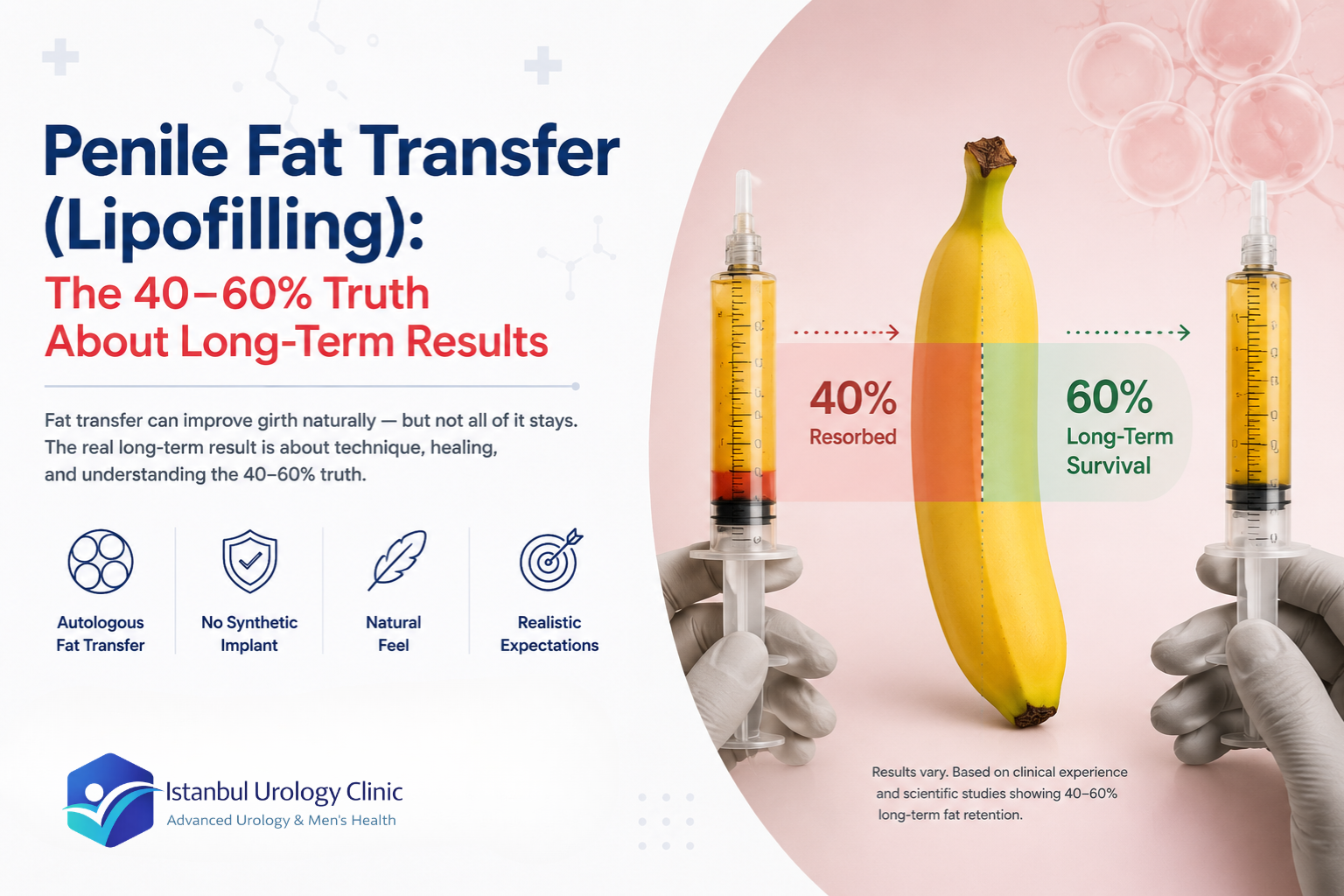
Girth and proportion improvement. This is where most of the visible change comes from in adult micropenis surgery, and it is the dimension that has the strongest effect on overall appearance. Volume is added around the existing shaft either through the patient’s own fat tissue, transferred from another area of the body, or through a custom silicone implant placed under the penile skin. Silicone delivers a permanent, predictable result. Fat transfer is partial because a portion of the transferred tissue is naturally reabsorbed by the body within the first months. The choice between them depends on anatomy, expectations, and how much maintenance the patient is willing to accept.
Combined procedures. For most adult micropenis cases evaluated at our clinic, the surgical plan combines length release with girth enhancement in the same operation. This is because addressing only one dimension often shifts the proportion problem rather than solving it. Length without girth can look thinner. Girth without length leaves the visible portion unchanged. The combined approach is the one that produces the most balanced result, and it is the path most adult micropenis candidates take when surgery is the right answer.
Full outcome ranges, exact centimetre figures, and per-technique recovery details are covered in our guide to penile enlargement surgery. For patients specifically interested in silicone-based girth solutions, the device-level comparison is covered in our dedicated guides on the Penuma Himplant and the Peniflex implant.
What Adult Surgery Cannot Do
No surgical option transforms a micropenis into an average penis. This is the conversation we have at every adult consultation, and it is the one that matters most. The starting anatomy sets the limit. Patients who begin below the diagnostic threshold do not finish above the population average, no matter what procedure combination they choose. The change is real, measurable, and meaningful in proportion, but it is not the dramatic transformation that pills, advertisements, and unregulated clinics imply.
This is the reason a meaningful number of patients choose not to proceed with surgery after evaluation. That decision is just as valid as the decision to operate, and the role of the consultation is to help you make the right one for your specific situation, not to push toward a procedure that does not match your goal.
A Note on Perception
One of the most useful pieces of clinical evidence in this conversation comes from a large systematic review by Veale and colleagues (2015), published in BJU International, which constructed reference nomograms for flaccid and erect penile length and circumference using measurements from more than fifteen thousand men. The study showed two things that matter for this conversation.
First, the normal range is wide, and the medical threshold for micropenis sits well below where most men assume it does. Second, perception of size is shaped far more by partner expectation, self-comparison, and psychological factors than by the measurement itself.
This does not change the situation for a patient who genuinely meets the diagnostic threshold. It changes it considerably for patients who arrive convinced they have micropenis when the measurement says otherwise, which remains the larger group we see in clinic.
Why Diagnosis Comes Before Surgery
Most clinics that advertise micropenis treatment begin the conversation with the procedure. Pricing, recovery, before-and-after expectations, package contents. The diagnosis sits in the background as something assumed rather than confirmed. The problem with that order is that it produces surgery for patients who did not need it, and it misses the patients who needed something different.
The order at Istanbul Urology Clinic is reversed for a reason. Confirm the diagnosis first. Then decide whether treatment is needed. Then choose the right one for that specific patient. Every section of this article has been built on that logic, because it is the same logic Prof. Dr. Onuk applies in every consultation.
What this means in practice is that the first visit is structured around examination, not booking. The stretched penile length is measured properly. The differential between true micropenis, concealed penis presentations, and normal anatomy with size anxiety is worked through in the same consultation, by the same surgeon. Hormonal evaluation is added when the measurement and history call for it, not by default. A meaningful share of patients who arrive expecting surgery leave with a clear diagnosis and no surgical plan at all, because none was medically appropriate. That outcome is treated as a successful consultation, not a failed one.
For international patients, this structure changes what the visit actually looks like. Rather than arriving for a pre-booked procedure, the trip is built around evaluation first, with the treatment decision made in person after the measurement and examination are complete. If surgery is the right answer, it is scheduled during the same visit. If it is not, the trip ends with a clear explanation, a written plan, and no procedure performed for the sake of justifying the travel.
This is the difference patients usually notice in the first thirty minutes of consultation. The conversation is not about which package they want. It is about what they actually have.
Frequently Asked Questions
In adults, micropenis is generally diagnosed when stretched penile length falls below approximately 7 to 8 cm, which is roughly 2.8 to 3.1 inches. The measurement is taken from the pubic bone to the tip of the glans while the penis is gently stretched. Anything above this range, even if it appears short visually, does not meet the medical criteria for the diagnosis.
In most adult cases, no. Hormonal therapy in an adult with true micropenis does not produce further growth, because the developmental window has closed. Non-surgical treatments are limited to specific situations, such as identifying associated hormonal conditions that need management for general health reasons. Pills, supplements, and creams sold online have no effect on penile size in adults. Adult treatment, when offered, is surgical.
Adult surgical options produce measurable but modest changes. Lengthening procedures improve visible length by releasing the suspensory ligament. Girth procedures change proportion by adding volume around the existing shaft. No procedure creates new penile tissue, and no patient who starts below the diagnostic threshold finishes above the population average. Full outcome ranges are detailed in our main guide on penis enlargement surgery in Turkey.
If you are unsure whether your concern is true micropenis, a concealed penis presentation, or normal anatomy with size anxiety, the right starting point is the same for all three. A single diagnostic consultation sorts the case into the correct pathway. The international patient team can also do a brief preliminary review by message before scheduling, so you know what kind of evaluation to plan for before you travel.
Length gains from suspensory ligament release are permanent because the anatomical structure that produced them does not reattach. Girth changes depend on the technique. Silicone implants are permanent. Fat transfer is partial, because a portion of the transferred fat is naturally reabsorbed over time. Filler-based techniques are temporary by nature. The specific permanence profile of each option is covered in our technique-level guides.
Erectile function and fertility depend more on the underlying cause than on penile size itself. Most patients with true micropenis maintain normal erections. Fertility outcomes vary based on the specific hormonal or genetic condition responsible for the diagnosis. Many men with true micropenis father children naturally. The diagnosis does not automatically mean infertility or sexual dysfunction.
Start With the Right Answer, Not the Wrong Procedure
Whether you need diagnostic confirmation that your anatomy is normal, correction of a concealed penis condition, or specialised adult treatment for true micropenis, the first step is the same. A proper evaluation. Done by a surgeon who has examined thousands of cases. Before any decision about treatment is made.
The diagnosis is the difference between the right procedure and the wrong one. The evaluation costs you a consultation. The wrong procedure costs you a lot more.